AI API Generation for Regulated Enterprises: A Verdict
AI API Generation for Regulated Enterprises: A Verdict

AI API generation means using AI to design and produce production-grade REST, GraphQL, gRPC, or SOAP APIs from plain-language intent, including the contract, tests, docs, and governance artifacts around it. It can be production-ready for healthcare, finance, and manufacturing environments, but only if the platform outputs controlled OpenAPI or AsyncAPI specs, automated tests, and audit trails wired into your CI/CD pipeline. The immediate next step is not picking a tool. It is running whatever platform you’re considering through the checklist below.
- Verdict: production-ready when contracts, tests, and governance artifacts are generated together, not separately.
- Next step: evaluate any platform against the capability checklist before committing budget.
Key Takeaways
AI-generated APIs earn a place in production only when the platform outputs controlled contracts, automated tests, and audit-grade governance artifacts as a single connected pipeline.
| Point | Details |
|---|---|
| Contract-first, always | Generate the OpenAPI or AsyncAPI spec and Interface Control Document together, under version control, before writing implementation code. |
| Gate on contract tests | Use consumer-driven contract testing with a broker to block deployments automatically when a change breaks a downstream consumer. |
| Bake in security primitives | Enforce TLS 1.3, mTLS or SPIFFE, and RBAC/ABAC at the gateway rather than adding them after generation. |
| Match retention to framework | Set audit log retention to the regulation in play, six years under HIPAA and seven under SOX, not a generic default. |
| Jundago maps directly to the checklist | API Studio, EndPlex, and Command Center generate contracts, tests, and governance artifacts together across multi-cloud deployments. |
Table of Contents
- Why AI-Generated APIs Matter in Regulated Environments
- What Should a Compliant AI API Platform Include?
- How Do You Roll Out AI API Generation Safely?
- Which Security Controls Do Generated APIs Need?
- What Testing Evidence Proves Compliance?
- How Do You Govern Generated APIs Long-Term?
- The Gap Between AI Speed and Regulatory Trust
- How Jundago Maps to the Compliance Checklist
- Sources
Why AI-Generated APIs Matter in Regulated Environments
Speed is the obvious draw. A platform that generates a contract, mock server, and test suite from a natural-language description turns a two-week integration sprint into an afternoon. The documentation comes out consistent because it’s produced from the same source as the code, not written separately by someone who forgot an edge case.
The catch is that regulators don’t care how fast you moved. They care whether the spec is traceable, whether someone can reconstruct what changed and why, and whether the version history holds up under audit. AI output has to feed directly into those artifacts, not sit beside them as a convenience layer.
- Pilot AI generation on low-risk, internal services first, where a bad contract costs you an afternoon, not a finding.
- Demand enterprise-grade controls (versioning, audit logs, risk traces) before anything touches a production endpoint handling regulated data.
Pro Tip: Run a 30-day internal pilot on a non-patient-facing, non-financial endpoint before you let AI-generated contracts anywhere near a system that touches PHI or PCI data.
What Should a Compliant AI API Platform Include?
Vendor demos look similar on the surface. What separates a platform that survives an audit from one that creates a liability is a specific set of capabilities, in priority order.
- Controlled contract generation. The platform must output an OpenAPI or AsyncAPI spec plus an Interface Control Document, version-controlled and tied to your change-control process under a quality management system.
- Automated contract testing. Look for consumer-driven contract tests with brokered artifacts that gate CI/CD deployments automatically, not manual sign-off after the fact.
- Security primitives baked in. TLS 1.3, mTLS or SPIFFE for service identity, RBAC/ABAC enforcement at the gateway, and short-lived tokens instead of static API keys.
- Compliance artifacts on generation. Risk analysis traces, tamper-evident audit logs, retention windows mapped to the frameworks you operate under, and support for BAAs or DPAs where third-party processors touch the data.
- Deployment flexibility. Single-tenant, on-prem, or bring-your-own-model options so data residency rules don’t force you into an architecture you can’t defend.
Auditors reviewing regulated APIs consistently ask for the same five things: an ICD, a documented risk analysis, a version-controlled OpenAPI spec, a versioning policy, and security controls traceable back to a recognized standard. A platform that can’t produce these on demand isn’t ready for production, no matter how clean its generated code looks.
How Do You Roll Out AI API Generation Safely?
The sequence matters more than the tool. Skip a step here and you end up with fast APIs nobody can defend in an audit.
- Generate contract-first artifacts. Have the AI produce the OpenAPI or AsyncAPI spec and an Interface Control Document together, then place both under change control before a single line of implementation code exists.
- Build mocks and tests in the same pass. Generate automated tests alongside the contract, then publish that contract to a broker so consumer-driven contract tests run against every consumer automatically.
- Add policy-as-code gates. Wire automated compliance checks into CI/CD so a spec that violates a security or data-residency rule never reaches a merge, and archive immutable build artifacts with timestamped test evidence.
- Pick your deployment model early. Decide on single-tenant, on-prem, or bring-your-own-model deployment before you scale, since retrofitting data-residency routing after launch is expensive and error-prone.
- Roll out in stages. Start with internal, low-exposure services. Move to production only once you have documented validation evidence and live monitoring in place.
Pro Tip: Archive every generated contract version, even the rejected ones. Auditors sometimes ask why a design changed, not just what it changed to.
Which Security Controls Do Generated APIs Need?
Generated code is only as trustworthy as the controls wrapped around it. These aren’t optional extras layered on later. They need to be part of the generation output itself.
- Transport and storage: TLS 1.3 for everything in transit, AES-256 at rest, and key rotation managed through a KMS or HSM rather than hardcoded secrets.
- Authentication and authorization: OAuth2 or OIDC for external clients, mTLS or SPIFFE for service-to-service calls, with RBAC and ABAC enforced at the API gateway rather than scattered across individual services.
- Data handling: de-identify data before it reaches any external AI inference call, secure BAAs or DPAs with third-party processors, and route sensitive workloads by policy to keep data inside the correct jurisdiction.
- Auditability: unique user attribution on every API call, tamper-evident logs, and retention windows that match the framework in play.
- Adaptive protections: complexity-based rate limiting, circuit breakers, and isolated inference contexts so one runaway AI call doesn’t cascade into a service-wide outage.
Retention isn’t a rounding error. HIPAA generally requires six years of audit log retention, while SOX requires seven, and getting that number wrong on a generated API is the kind of gap an auditor finds in the first hour.
What Testing Evidence Proves Compliance?
Passing tests once isn’t the bar. Regulators want continuous, reproducible proof that the contract you shipped is the contract you’re still running.
- Treat the OpenAPI spec as a controlled document. Record every approval, every review, and link each version to the test artifacts that validated it.
- Run consumer-driven contract tests through a broker. Tools like Pact catch breaking changes before they hit a downstream consumer, and gate the deployment automatically when a contract fails.
- Scale testing to risk. Apply heavier, more rigorous test coverage to high-risk endpoints, following a risk-based approach consistent with FDA Computer Software Assurance or EN 62304 for medical software.
- Archive immutable, timestamped evidence. Test logs and audit trails need to survive intact for years, aligned with the kind of record-keeping 21 CFR Part 11 expects.
- Bake in schema enforcement, fuzzing, and load testing as standard generation output, not bolt-on QA work someone does later.
The contract, the tests that prove conformance to it, and the process governing how the contract changes are the three things that actually get validated in a regulated environment. Everything else is implementation detail.
How Do You Govern Generated APIs Long-Term?
An API generated on Monday still needs an owner on the anniversary of its launch. Governance is what keeps a fast pipeline from turning into an unmanaged sprawl of endpoints nobody remembers approving.
- Define what counts as a regulatory-breaking change versus a routine update, and require a significance assessment before either ships.
- Route every change through a review workflow tied to your QMS, with documented intended purpose and a clear deprecation timeline for retired versions.
- Tie incident response directly to your audit logs, and know your regulatory notification clock. GDPR gives you 72 hours to report a qualifying breach.
- Assign a named product owner to every generated API and schedule periodic compliance reviews rather than treating launch as the finish line.
- Monitor AI inference behavior over time for drift or bias, and fold that surveillance into the same governance process that tracks everything else.
Pro Tip: Put a calendar reminder on every generated API’s first compliance review the same day it goes live. Six months out feels distant at launch and arrives faster than teams expect.
The Gap Between AI Speed and Regulatory Trust
Most of the enthusiasm around AI-generated APIs focuses on velocity: how fast the contract appears, how quickly the mock server spins up. That’s the wrong metric for a regulated team. The right one is whether the artifact trail survives an audit eighteen months later, and most platforms simply weren’t built with that trail in mind.
The conventional advice, generate first and bolt on compliance later, gets the sequence backward. Retrofitting an audit trail onto code that already shipped is slower and riskier than building the trail into generation from day one. If the platform can’t produce a version-controlled spec, a risk trace, and a test artifact the moment it produces the endpoint, you’re not saving time. You’re deferring the cost and adding interest.
What the evidence in this piece actually supports is narrower than the hype: AI can absolutely handle contract generation, test scaffolding, and documentation at a pace no human team can match. But treating those outputs as first-class governed artifacts, not conveniences, is what separates a pilot from a production system. Prioritize the platforms that generate the paper trail alongside the code. Everything else is a demo.
— vivek
How Jundago Maps to the Compliance Checklist
Every capability in the checklist above corresponds to a specific piece of Jundago’s platform, not a marketing claim layered on top of it. API Studio generates contracts and Interface Control Documents directly from intent, in REST, GraphQL, gRPC, or SOAP, so the spec and the ICD exist together from the first draft.
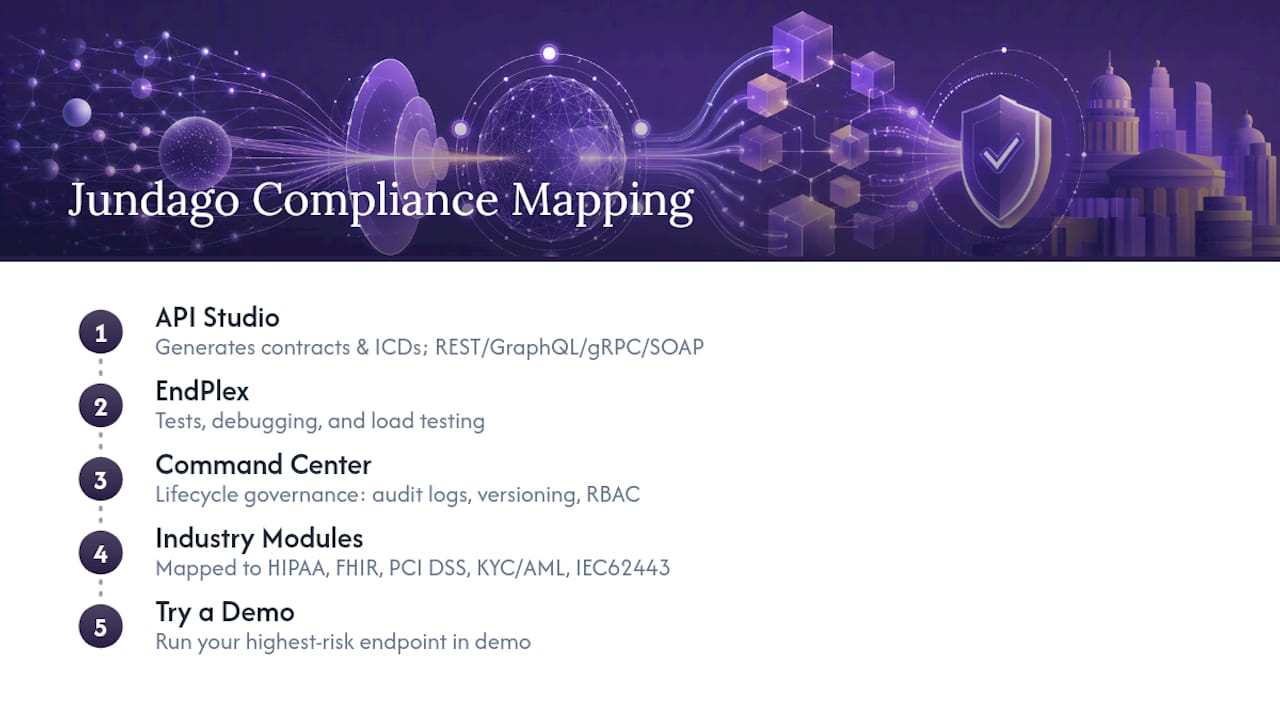
EndPlex, the native API workbench with an AI Assistant, handles generated tests, debugging, and load testing in one place, so contract validation isn’t a separate project bolted on after the fact. Command Center governs the whole lifecycle across AWS, Azure, GCP, and Oracle Cloud, giving you the audit logging, versioning, and RBAC/ABAC enforcement that regulated deployments require, along with deployment options built for data residency. Healthcare, finance, and manufacturing teams get industry modules mapped to HIPAA, HL7 FHIR, PCI DSS, KYC/AML, and IEC 62443 out of the box, instead of generic controls you have to adapt yourself. If your team is evaluating platforms against the checklist in this article, request a Jundago demo and run your own highest-risk endpoint through it first.
Sources
- API Design for Medical Devices: Regulatory Considerations Under MDR
- API-First Modernization in Regulated Pharma Environments
- API Compliance: GDPR, SOX & HIPAA Guide 2026 | APIScout
- Building Compliance APIs in 2025: Security Standards for Regulated Industries