API Versioning Strategy: Pragmatic Defaults for 2026
API Versioning Strategy: Pragmatic Defaults for 2026

For most public REST APIs, use URI path versioning as the default, bump the version only when you break a contract, and give consumers a 12-month deprecation runway announced through an RFC 8594 Sunset header. Reserve date-based versioning for platform-scale teams with real engineering budget. Everything else, including additive changes like new optional fields, ships without a version bump at all.
TL;DR:
- Most APIs should use URI path versioning as the default, bump versions only for breaking changes, and provide a 12-month deprecation window with an RFC 8594 Sunset header.
- Breaking changes include removing or renaming fields, data type alterations, or changing response status codes, while additive changes like new optional fields do not require a version bump.
- Header-based and date-based versioning introduce operational complexities and cache issues, making URI path versioning the best default choice for public APIs.
- Enforcing version discipline with automated contract tests, RFC headers, and clear migration policies prevents silent breaking changes and technical debt from accumulating.
- Examples like Stripe and GitHub demonstrate strong versioning practices: Stripe pins to date-based versions for stability, while GitHub uses path versioning for major updates and headers for finer control.
Table of Contents
- What Is API Versioning and Why It Matters
- When Should You Create a New API Version?
- Comparing URI Path, Query Param, Header, and Date-Based Versioning
- Best Practices That Keep Versioning From Becoming Debt
- How to Roll Out a New API Version, Step by Step
- GraphQL and gRPC Change the Versioning Calculus
- How Jundago Operationalizes Version Discipline
- Versioning Strategies for Webhooks and Event-Driven APIs
- Handling Client Version Negotiation and Fallback
- How Versioning Shapes Your CI/CD Pipeline
- Real-World Patterns Worth Studying
- What Most Teams Get Wrong About Versioning
- Try Jundago for Version-Safe API Delivery
- Sources
What Is API Versioning and Why It Matters
API versioning is the discipline of managing changes to your contract without breaking the applications already calling it. It’s the difference between deploying with confidence and deploying with your fingers crossed.
The definition sounds simple, but the mechanics matter: you’re not versioning code, you’re versioning a promise. Every consumer who integrated against your endpoint made assumptions about field names, data types, response shapes, and status codes. Versioning is how you change those assumptions on your own timeline instead of theirs.
Done right, it buys you three things. Backward compatibility means existing integrations keep working while you ship improvements underneath them. Predictable evolution means partner teams can plan migrations instead of firefighting them. And protected revenue means a payments integration or a healthcare data feed doesn’t silently die because someone renamed a field on a Tuesday.
Done poorly, the costs show up fast:
- Support tickets spike when a “minor” change breaks a client’s parser
- Production incidents happen silently, often discovered by customers before your monitoring catches them
- Trust erodes, and partners start building defensive workarounds instead of adopting your new features
- Engineering time gets eaten by emergency hotfixes instead of planned migrations
The freeCodeCamp guide to REST API versioning frames this well: versioning exists specifically to separate breaking changes from everything else, so consumers only have to pay attention when it actually matters.
When Should You Create a New API Version?
Most versioning debates collapse the moment you have a clear rule for what counts as breaking. Here’s the checklist.
Changes that require a new version:
- Removing a field, endpoint, or parameter that clients currently depend on
- Renaming any field, path segment, or query parameter
- Changing a data type (a string ID becomes an integer, a timestamp format changes)
- Tightening validation rules that previously accepted a broader set of inputs
- Making a previously optional parameter required
- Changing status codes or error response structures for existing scenarios
Changes that do not require a version bump:
- Adding a new optional field to a response
- Adding an entirely new endpoint
- Adding a new optional request parameter with a sensible default
- Loosening validation (accepting more, not less)
The freeCodeCamp breakdown of breaking versus additive changes draws this same line: additive changes are safe by definition because no existing client code has to change to keep working.
The operational rule when a change sits in a gray zone: treat it as breaking. The cost of an unnecessary version bump is minor annoyance. The cost of a silent breaking change is a production incident at 2 a.m. Document every versioning decision in your changelog with the reasoning, not just the diff, so the next engineer doesn’t relitigate the same judgment call six months later.
Pro Tip: Add a contract test the moment you’re unsure whether a change is breaking. If the test fails against the old version’s expectations, you have your answer, and you have a regression guard for free.
Comparing URI Path, Query Param, Header, and Date-Based Versioning
Four methods dominate real-world API versioning strategy, and each one trades a different set of costs. There’s no universally correct choice here. There’s a correct choice for your consumers, your CDN setup, and your engineering headcount.
URI path versioning puts the version in the URL itself: /v2/orders. It’s the method most public APIs choose, and for good reason.
Query parameter versioning passes the version as a parameter: /orders?version=2. It looks flexible but tends to complicate caching and routing more than it simplifies anything.
Header (media-type) versioning keeps the URL clean and negotiates the version through an Accept header or a custom header like Api-Version. REST purists tend to favor this because the resource identifier stays stable.
Date-based versioning ties versions to a release date (2026-01-15) rather than a number, often combined with per-account pinning so each customer can sit on the version that works for them.
| Dimension | URI path | Query param | Header/media-type | Date-based |
|---|---|---|---|---|
| Cacheability at CDN/edge | Excellent, URL is the cache key | Poor to moderate, depends on query handling | Requires correct Vary header or CDNs serve wrong version |
Excellent, same as URI path when combined with path |
| Debug-friendliness | Easy to curl and inspect directly | Easy but easy to forget in a shared link | Hard, version is invisible in the URL bar | Easy if exposed in path, harder if only in metadata |
| Client effort | Low, update a base URL | Low, add a query string | Moderate, clients must set headers correctly | Moderate to high, clients track dates or pin accounts |
| Operational/engineering tax | Low | Low to moderate | Moderate to high, Vary misconfiguration risk |
High, requires transformer chains and account-level routing |
| Best for | Public APIs, most teams | Rarely the best default for any scenario | Controlled internal or partner APIs with disciplined clients | High-volume platform APIs with dedicated platform teams |
The cache story deserves its own callout. Non-URL strategies depend entirely on the Vary header being set correctly, and a lot of teams underestimate this until a CDN starts serving version 1 responses to version 2 clients because the cache key never accounted for the header. That’s not a hypothetical. It’s the most common operational failure mode in header-based versioning, and it usually surfaces as a support ticket, not a monitoring alert.
Date-based versioning solves a different problem entirely: it lets platforms the size of Stripe ship frequent breaking changes without forcing every merchant onto the same release schedule, since each account can pin to the date-version that matches its integration. That flexibility comes at a real cost. You need transformer chains that translate requests and responses between versions, and someone has to own that translation logic indefinitely.
Rules of thumb worth following:
- Default to URI path versioning unless you have a specific reason not to
- Use header-based versioning only when your client base is small, disciplined, and you control both ends of the integration
- Reserve date-based versioning for platforms with dedicated infrastructure investment and genuinely high version churn
- Never use query parameters as your primary strategy. Cache and routing headaches almost always outweigh the flexibility
The Azure API Management documentation covers implementation patterns for all four approaches at the gateway level, which is worth a read if you’re deciding how to enforce versioning at the routing layer rather than in application code.
Best Practices That Keep Versioning From Becoming Debt
Versioning strategy fails less often because of the wrong method and more often because of missing operational discipline around whatever method got picked.
Four practices separate teams that manage versions cleanly from teams drowning in them:
- Publish a full OpenAPI 3.x specification for every live version, and generate client SDKs directly from that spec rather than hand-writing them
- Attach RFC 8594 Sunset headers and Deprecation headers to every deprecated version’s responses, and give paid or enterprise APIs a minimum 12-month runway before shutdown
- Run contract tests against every supported version inside your CI pipeline, with a merge gate that blocks any change violating a published contract
- Pin SDK versions explicitly in your documentation and publish a migration guide alongside every changelog entry
The OpenAPI-per-version habit matters more than it sounds. Without a locked specification for each version, contract drift creeps in silently. Someone adds a field in a hot fix, forgets to update the spec, and six months later nobody can say with confidence what version 3 actually guarantees.
Sunset and Deprecation headers matter for a similar reason: they turn deprecation from a blog post nobody reads into a machine-readable signal a client’s own monitoring can catch. RFC 9745 complements RFC 8594 by giving clients a standard Deprecation header to check programmatically, on top of the Sunset date. Together they let you say “this ends March 2027” in a way code can act on, not just a human reading changelog.
Pro Tip: Set the Sunset header the day you announce deprecation, not the week before shutdown. A 12-month runway with no header until month 11 is functionally a 1-month runway for anyone monitoring headers instead of reading email.
Semantic versioning principles apply cleanly to the SDK layer even when your API itself doesn’t use semver numbering: major bumps for breaking changes, minor for additive features, patch for fixes. The discipline behind semver matters more than whether you literally adopt its numbering scheme.
How to Roll Out a New API Version, Step by Step
Introducing a new version safely follows a fairly consistent sequence regardless of which method you’re using.
- Classify the change. Decide whether it’s breaking or additive using the checklist above, and pick your exposure method (path, header, or date) based on who your consumers are and how much CDN control you have.
- Write the OpenAPI contract first. Draft the new version’s specification before writing implementation code. This forces you to see the full shape of the change before you commit to it.
- Build routing or transformer logic. If you’re using anything other than URI path versioning, configure your gateway or CDN’s
Varyheader correctly at this stage, not after launch. - Add contract tests and CI gates. Every version you support needs its own test suite validating responses against its own OpenAPI spec, wired into your pipeline so a violation blocks the merge.
- Ship and monitor. Deploy the new version alongside the old one and track adoption metrics, not just uptime.
- Announce deprecation with a Sunset header. The moment you commit to retiring the old version, add the header and start the runway clock publicly.
- Enforce the sunset. After the runway ends, return
410 Goneon the retired version rather than leaving it to rot indefinitely as a security and maintenance liability.
Skipping step 2 is the single most common shortcut teams take, and it’s the one that causes the most downstream pain, because implementation details end up defining the contract instead of the other way around.
GraphQL and gRPC Change the Versioning Calculus
Schema-based protocols sidestep most of the versioning problem REST APIs face, and pretending otherwise just adds unnecessary complexity.
- GraphQL favors field-level
@deprecateddirectives over whole-schema versioning; you mark a field deprecated, keep it functional, and let clients migrate at their own pace - Additive field evolution is the default GraphQL pattern: add new fields freely, deprecate old ones gradually, and reserve full schema versioning for genuinely incompatible type-system changes
- gRPC and Protocol Buffers evolve through wire-compatible rules: never reuse field numbers, add new fields as optional, and use package-level version metadata rather than versioning every service
- API-level versioning still makes sense when you’re changing the fundamental contract shape, not just individual fields or messages
If you’re running GraphQL and still tempted to version the whole schema for every change, that’s usually a sign the deprecation discipline is missing, not that GraphQL needs REST-style versioning.
How Jundago Operationalizes Version Discipline
Enforcing everything above by hand, across dozens of services and multiple protocols, is where most teams lose the thread. Jundago builds these controls into the platform layer instead of leaving them to individual engineering discipline.
- API Studio generates REST, GraphQL, gRPC, and SOAP APIs from intent, producing a per-version OpenAPI specification automatically so the contract and the implementation never drift apart
- Contract testing runs automatically against each version’s spec as part of the governed pipeline, catching breaking changes before they reach production
- RBAC and ABAC governance enforce who can promote, deprecate, or retire a version, so a single engineer can’t accidentally sunset a contract enterprise partners depend on
- Machine-readable deprecation signaling, including Sunset and Deprecation headers, integrates directly into monitoring and SDK tooling rather than requiring manual header management on every deprecated route
For regulated industries where a broken integration means a compliance incident, not just an annoyed developer, that level of automated enforcement changes the calculation on how much versioning discipline is realistic to maintain by hand.
Versioning Strategies for Webhooks and Event-Driven APIs
Webhooks and event streams break the usual versioning playbook because you don’t control when the consumer pulls data. You’re pushing it, often to a receiver you can’t coordinate a deploy with.
The safest pattern is an event envelope that carries its own version field, separate from any URL or header. A payload like {"event_version": "2026-01", "type": "order.updated", "data": {...}} lets consumers branch their handling logic on the version field itself, without needing a new subscription URL for every schema change.

Additive changes to event payloads follow the same rule as REST: new optional fields are safe, removed or renamed fields are not. The complication is that webhook consumers often can’t easily signal “I’m still on the old schema” the way an HTTP client can send an Accept header. That makes explicit version fields in the payload more important for events than for synchronous APIs, not less.
For genuinely breaking event schema changes, run parallel event types or topics for a transition period, mirroring the same 12-month runway logic used for REST endpoints, and give consumers a way to subscribe to both the old and new shape during migration. Kafka-based and other event-driven architectures often solve this with topic versioning (orders.v1, orders.v2) rather than payload-level version fields, which has the added benefit of letting consumers migrate topic-by-topic instead of parsing conditional logic inside every handler.
Whatever mechanism you pick, document the event contract with the same rigor as a REST OpenAPI spec. An undocumented webhook payload is a breaking change waiting to happen the next time someone touches the producer code.
Handling Client Version Negotiation and Fallback
Version negotiation is the mechanism by which a client tells your API which contract it expects, and your API decides how to respond when that expectation can’t be met exactly.
For header-based versioning, this typically runs through content negotiation: a client sends Accept: application/vnd.yourapi.v2+json, and your server either returns that version or a 406 Not Acceptable if it’s no longer supported. The clean failure mode matters here. A client that gets a 406 can fail loudly and alert someone, while a client that silently receives a mismatched version can corrupt data quietly for weeks.
Fallback strategy depends on your risk tolerance. Some teams default unspecified requests to the latest version, which is convenient for new integrations but dangerous for old ones that never pinned a version explicitly and start receiving breaking changes without warning. A safer default is to require an explicit version on every request, with no implicit fallback, and reject anything unversioned with a clear error message pointing to your documentation.
For URI path versioning, negotiation is simpler because the version is unambiguous in the request itself, but the fallback question shifts to your gateway: does an unrecognized path segment 404 immediately, or does it attempt to match the closest supported version? The former is more predictable and easier to debug. The latter feels friendlier until it silently masks a client’s typo in production.
Whichever pattern you choose, log every version mismatch and negotiation failure. Those logs are usually the earliest signal that a major consumer is stuck on a version you’re trying to retire, well before your own migration dashboards catch it.
How Versioning Shapes Your CI/CD Pipeline
Versioning isn’t a one-time architectural decision. It’s an ongoing input into every deploy, and pipelines that don’t account for it eventually ship a breaking change straight to production without anyone noticing until support tickets arrive.
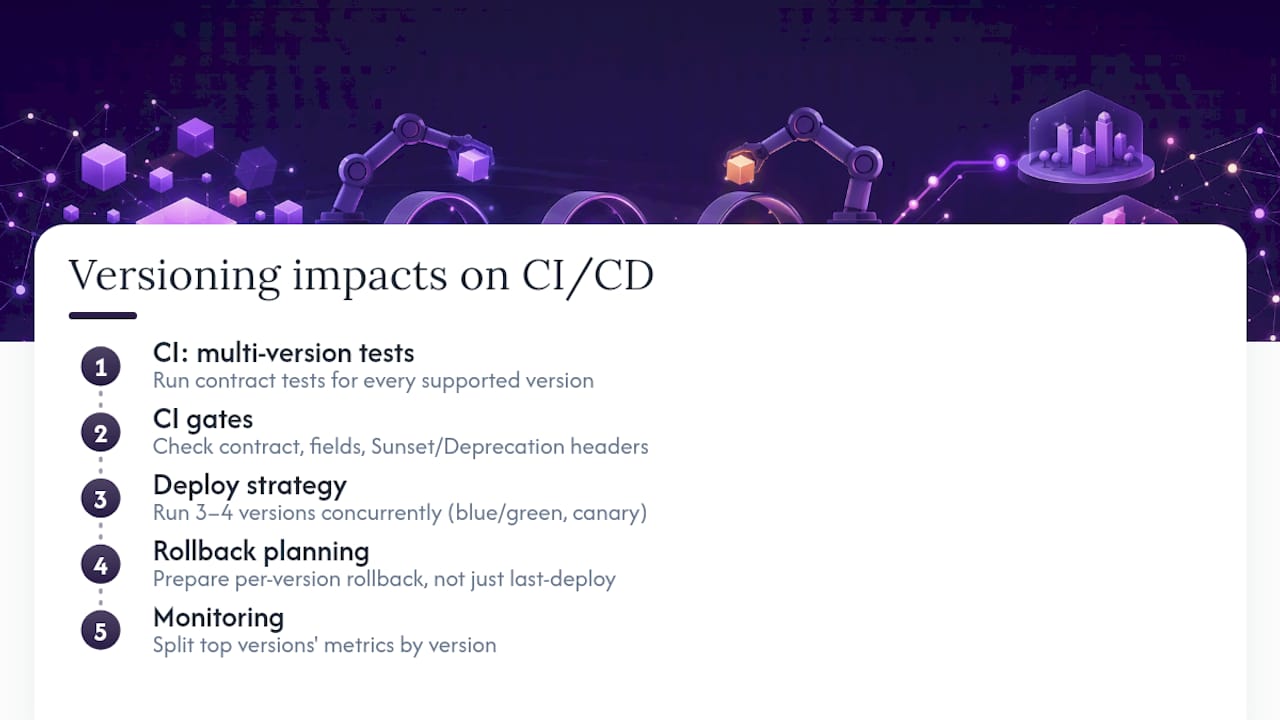
The core shift is that your CI pipeline needs to validate against multiple live contracts simultaneously, not just the current codebase’s behavior. That means running contract tests for every supported version on every merge, not just the version currently under active development. A change that looks safe against v3’s test suite can quietly violate v2’s contract if both versions share underlying code paths, which they usually do.
Version-aware CI gates typically check three things before allowing a merge: that the new code still satisfies every currently supported version’s OpenAPI contract, that no removed or renamed field slipped through without a version bump, and that deprecated versions still return the correct Sunset and Deprecation headers rather than silently dropping them during a refactor.
Deployment strategy changes too. Blue green or canary deploys need to account for the fact that you might be running three or four API versions in production simultaneously, each with different consumers depending on different behavior. A rollback plan that only considers “the last deploy” isn’t sufficient when a regression might only affect v2 traffic while v3 is fine.
The lifecycle impact extends past deployment into monitoring. Dashboards that track error rates and latency in aggregate hide version-specific problems. Splitting metrics by version, at minimum for your top few versions by traffic volume, is often the difference between catching a v2-only regression in an hour versus discovering it a week later through a support escalation.
Real-World Patterns Worth Studying
A handful of well-known versioning approaches illustrate the trade-offs discussed above in practice, without needing invented numbers to make the point.
Stripe’s approach is the most commonly cited example of date-based versioning done well: each merchant account pins to a specific dated version, and Stripe maintains transformer logic internally to translate between versions so old integrations keep working years after their pinned date. This is the platform-scale pattern described earlier in the comparison, and it’s a deliberate trade of engineering investment for merchant stability. Stripe can ship breaking changes to new integrations constantly without ever forcing existing merchants to migrate on Stripe’s schedule.
GitHub’s REST API takes the URI path route, with versions like v3 embedded directly in the URL and a separate header-based mechanism for finer-grained API feature flags. It’s a hybrid that leans on path versioning for the big, infrequent breaking changes and header negotiation for smaller, opt-in behavior changes, which shows the two methods aren’t mutually exclusive within a single API surface.
GraphQL-first platforms tend to avoid whole-API versioning entirely in favor of the field-level deprecation pattern described earlier, letting a schema evolve continuously rather than in discrete version jumps. The pattern trades a single big migration event for a steady trickle of smaller ones, which many teams find easier to absorb operationally even if it requires more disciplined schema governance day to day.
What these examples share isn’t a specific method. It’s the underlying commitment: pick a strategy that matches your consumer base and operational capacity, then enforce it with the same rigor as any other production contract.
What Most Teams Get Wrong About Versioning
The most common failure is treating versioning as a naming exercise instead of a contract discipline. Teams bump a number in the URL and call it done, without adding contract tests or a deprecation policy behind it. That’s not versioning. That’s relabeling.
The second failure is forgetting Sunset headers entirely and running four “current” versions simultaneously because nobody wanted to make the call to retire anything. Every live version you maintain is a promise you’re actively keeping, and unkept promises accumulate as technical debt whether or not anyone’s tracking them.
The fix isn’t more process. It’s treating your API contract as a product responsibility, not just an engineering artifact. Publish the deprecation policy publicly. Make migration genuinely low-friction with real SDKs and real guides. Institutionalize contract tests so breaking changes get caught by CI, not by an angry integration partner.
— vivek
Try Jundago for Version-Safe API Delivery
Jundago is built for teams that need the practices in this article enforced automatically, not maintained by hand across a growing number of services. API Studio generates per-version OpenAPI specs directly from intent, so contract drift stops being a recurring incident and starts being a solved problem. Contract testing runs inside the governed pipeline, RBAC and ABAC controls decide who can promote or retire a version, and machine-readable deprecation signaling ties into your monitoring without custom header management on every route.
That combination cuts the real cost of versioning: not picking a method, but sustaining the discipline behind it release after release, across REST, GraphQL, gRPC, and SOAP at once. If you’re managing versioning by spreadsheet and tribal knowledge right now, see how Jundago’s platform handles generation, testing, and governance in one workflow, and request a demo to see your own API surface mapped into it.