Stop Quarterly Audits: Compliance Automation APIs for Regulated Teams
Stop Quarterly Audits: Compliance Automation APIs for Regulated Teams

Compliance automation APIs give developer and compliance teams continuous evidence, real-time policy enforcement, and auditor-ready artifacts for every API in production. They replace quarterly spreadsheet audits with live, machine-readable proof that a system actually behaves the way its policy says it should. Regulated fintech and healthcare teams use them to prove PCI DSS, GDPR, and HIPAA controls without slowing releases.
TL;DR:
- API discovery and continuous drift detection are essential to prevent unnoticed endpoints from becoming compliance risks or security breaches.
- Enforcement must occur at runtime with signed, tamper-evident evidence generation to satisfy audit requirements and avoid manual, error-prone processes.
- Regulations like PCI DSS, GDPR, and HIPAA demand ongoing, machine-readable proof of API compliance, with specific controls mapped to each framework.
- Common failure modes include shadow APIs, version drift, permissive access, missing tamper-proof evidence, and mismatches between staging and production environments.
- Integrating compliance into the development pipeline from the start, with open standards like OpenAPI, OAuth, and JSON Schema, reduces manual effort and improves audit readiness.
Table of Contents
- Why Compliance Automation APIs Matter Right Now
- Core Components of Compliance Automation APIs
- Regulatory Frameworks and How They Map to API Controls
- Common Risks and Failure Modes for Compliance Automation APIs
- Implementation Patterns and Best Practices
- Developer Checklist for Evaluating a Compliance Automation API
- Where Compliance Automation APIs Are Headed
- Compliance Automation APIs in Practice
- Challenges and Limitations Teams Should Expect
- Key Technologies and Standards Behind Compliance Automation
- A Practical Roadmap, and Where I’d Push Back on Convention
- How Jundago Handles Compliance Automation for Regulated APIs
- Sources
Why Compliance Automation APIs Matter Right Now
Cloud-native architectures have multiplied the number of APIs a typical fintech or healthcare company runs, and each one is a potential entry point for a breach or an audit finding. API compliance now demands visibility, policy enforcement, and continuous monitoring, not a one-time checklist run before an audit window opens.
Regulators have caught up with this reality. PCI DSS v4.0 added explicit API-related requirements around inventorying custom software and continuous testing, and GDPR enforcement has grown teeth. The Dutch Data Protection Authority fined Uber €290 million over cross-border driver data transfers, a reminder that data-handling failures at the API layer carry direct financial consequences.
The business fallout from gaps shows up in a few consistent places:
- Regulatory fines tied to data transfer, retention, or access violations
- Audit findings that stall product launches or partner integrations
- Customer churn after a breach traced to an undocumented or misconfigured endpoint
- Engineering time lost to manual evidence gathering instead of building features
Core Components of Compliance Automation APIs
A compliance automation API earns its name only if it does more than generate a report once a quarter. Look for five capabilities working together.
Live inventory and drift detection comes first. Static spreadsheets go stale within weeks; you need a system that continuously discovers endpoints and flags when production behavior diverges from the published spec. API conformance tools compare live traffic against documented contracts and surface drift automatically, which matters because auditors increasingly treat spec mismatches as noncompliance regardless of what controls exist on paper.
Policy enforcement covers schema validation, field-level masking, and role- or attribute-based access control (RBAC/ABAC) applied at the gateway or runtime layer, not just in code review.
Automated evidence and auditor workflows turn enforcement logs into something a third-party auditor can actually use, ideally as signed, tamper-evident reports rather than raw log dumps.
Integration surfaces let the API plug into CI/CD pipelines and runtime observability stacks so compliance checks run automatically, not manually.
Testing and conformance features validate that staging behavior matches production before code ships.
Here’s how those map to daily work:
- Inventory and drift detection: catches the API nobody remembers deploying
- Policy enforcement: blocks a request before it violates a rule, not after
- Evidence generation: produces the artifact an auditor asks for on day one
- CI/CD integration: fails a build when a schema breaks policy
- Conformance testing: confirms the spec and the running service actually agree
Pro Tip: Ask any compliance API vendor to show you a signed evidence report, not a dashboard screenshot. If they can’t produce a cryptographically verifiable artifact on demand, your auditors will ask for one anyway, and you’ll be back to manual work.
Regulatory Frameworks and How They Map to API Controls
Every major regulation eventually translates into a specific, testable API control. Knowing the mapping saves weeks of guesswork during audit prep.
- PCI DSS v4.x: requires continuous inventorying of APIs and custom scripts, ongoing testing rather than annual snapshots, and protections around payment pages and third-party scripts, per Akamai’s breakdown of the v4.0 requirements.
- GDPR: governs data residency, consent capture, and subject access requests, all of which typically flow through APIs that need audit trails showing who accessed what data and why.
- HIPAA: mandates access controls around protected health information (PHI), detailed audit trails, and encryption both in transit and at rest, enforced at the API gateway layer.
- NIST/ISO baselines: the NIST Cybersecurity Framework organizes governance around identify, protect, detect, respond, and recover, a structure that maps cleanly onto API logging, monitoring, and incident response programs.
The common thread across all four: regulators want continuous, machine-readable proof, not a PDF someone updates once a year. A compliance automation API is the mechanism that keeps that proof current without adding headcount every time a new rule lands.
Common Risks and Failure Modes for Compliance Automation APIs
Most compliance gaps trace back to a handful of repeat offenders:
- Shadow and undocumented APIs. A service ships without registering in the inventory, and it sits invisible until a scan or a breach finds it.
- Version drift. The spec says one thing; the deployed service does another, often because a hotfix skipped the documentation step.
- Over-permissive auth. Broad API keys or roles get granted for convenience and never get scoped back down, violating least-privilege principles.
- Missing telemetry or signed evidence. Logs exist, but nothing ties them together into a defensible, tamper-evident record an auditor will accept.
- Preproduction and production mismatch. Tests pass in staging against a mocked dependency, then the real integration behaves differently under load or with live data.
Each of these is individually survivable. Stacked together, they’re what turns a routine audit into a finding.
Implementation Patterns and Best Practices
Shifting compliance left, into the development pipeline, is the single highest-leverage move a team can make.
- Validate OpenAPI specs and run contract tests in CI. Every pull request that touches an API contract should trigger schema validation and dependency checks (software composition analysis) before merge, not after deployment.
- Gate releases on conformance, not just test coverage. A build that breaks a documented contract should fail the same way a build with a failing unit test fails. IBM’s API Connect governance service, for instance, runs ruleset validation against OpenAPI and AsyncAPI documents during pull requests and pre-release gates.
- Enforce policy at runtime, not just at build time. Schema validation, field masking, and policy engines need to run against live traffic, because a spec that looked compliant in review can still drift once real users hit it.
- Automate remediation, not just detection. A violation should generate an alert with an SLA attached and, ideally, open a ticket automatically, rather than landing in a dashboard nobody checks.
The security industry increasingly frames this as adopting a positive security model: define what’s allowed through schemas and central policy engines, and reject everything else by default, rather than trying to enumerate every possible bad actor. That framing, described in F5’s analysis of PCI DSS 4.0.1 and API security, flips the usual blocklist mentality on its head.
Pro Tip: Run governance validation at three separate checkpoints: on every pull request, before every release, and on a recurring schedule in your management console. Drift doesn’t only happen at deploy time. It happens when a downstream service quietly changes behavior weeks later.
Developer Checklist for Evaluating a Compliance Automation API
Before you commit engineering time to build in-house tooling or buy a platform, run through this checklist.
- Does it discover APIs in real time, with version history, or does it rely on manual registration?
- Can conformance tests plug directly into your existing CI/CD pipeline without custom glue code?
- How granular is policy enforcement — field-level masking, RBAC, ABAC, or just coarse allow/deny rules?
- Does it generate signed, exportable evidence an external auditor can verify independently?
- What auth types does it support, and how long does it retain logs and telemetry?
| Evaluation criteria | What to look for |
|---|---|
| Discovery | Real-time, versioned inventory with drift alerts |
| CI/CD integration | Native pipeline hooks, not manual export/import |
| Policy granularity | Field-level masking plus RBAC/ABAC, not just endpoint blocking |
| Evidence output | Signed, tamper-evident reports auditors can verify |
| Auth and telemetry | Modern auth support with defined log retention windows |
Where Compliance Automation APIs Are Headed
The next phase of this technology looks less like dashboards and more like embedded infrastructure. AI-assisted policy generation is starting to translate plain-language regulatory text into machine-enforceable rules, cutting the lag between a new regulation and an enforced control from months to days.
Continuous, real-time evidence is becoming the baseline expectation rather than a premium feature. Auditors already treat static inventories as insufficient, and that expectation will keep tightening as more frameworks add explicit API language the way PCI DSS v4.x did.
Expect deeper convergence between API management and compliance tooling too. Governance, testing, and generation are consolidating into single platforms instead of a patchwork of point solutions stitched together with scripts. That consolidation matters most for teams running multi-cloud deployments across AWS, Azure, GCP, and Oracle Cloud, where consistent policy enforcement across providers has historically required duplicating work four times over.
Standardized, cryptographically signed evidence bundles are also gaining traction as a shared language between vendors, auditors, and regulators, since a signed and tamper-evident audit report removes the ambiguity of a self-reported spreadsheet. As that standard spreads, expect regulators to start asking for it by name rather than accepting whatever format a company happens to produce.
Compliance Automation APIs in Practice
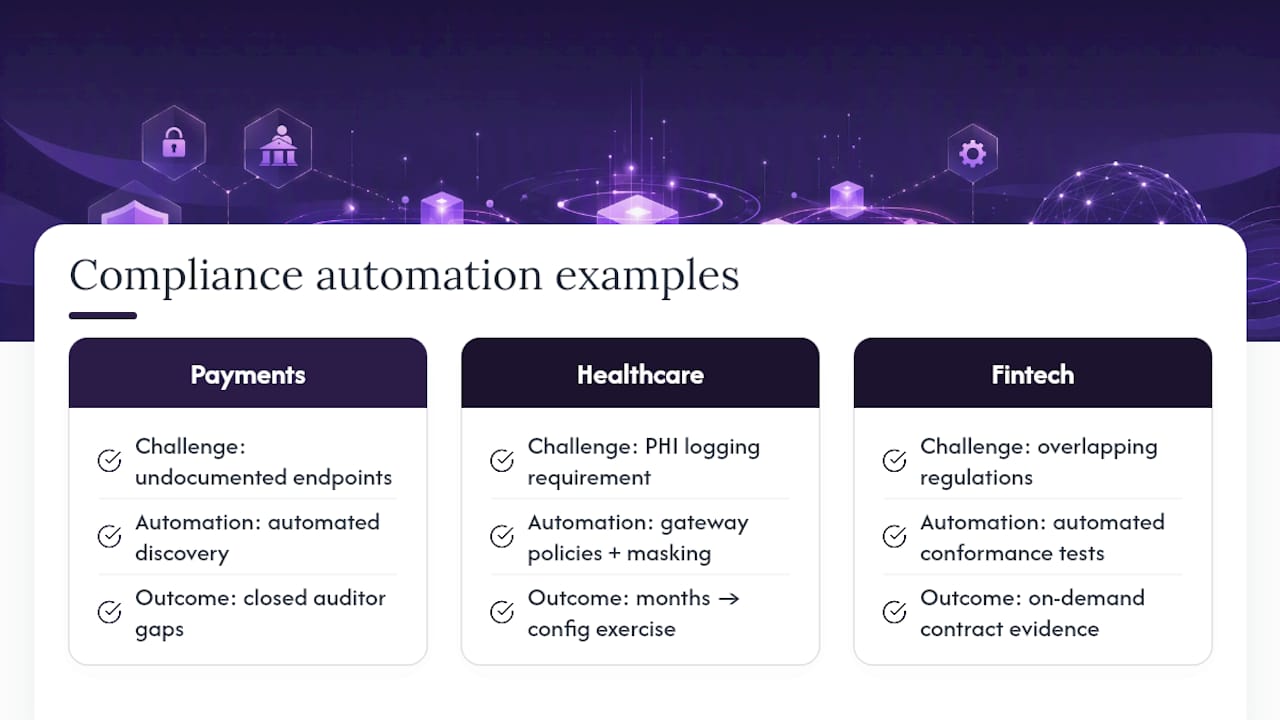
A mid-size payment processor handling card transactions illustrates the pattern well. Facing PCI DSS v4.0’s new requirements around continuous API visibility, the team moved from an annual manual inventory to automated discovery that flags every new endpoint within minutes of deployment. That shift alone closed a gap auditors had flagged twice in prior years: services spun up for a marketing campaign or a partner integration that never made it into the official inventory.
A healthcare API gateway serving multiple hospital systems offers a different lesson. HIPAA’s audit trail requirements meant every request touching protected health information needed a verifiable log entry tied to a specific user and purpose. Building that manually across dozens of microservices would have consumed a full engineering quarter. Automating policy enforcement at the gateway layer, with masking rules applied consistently regardless of which service handled the request, turned a months-long project into a configuration exercise.
A fintech company running open banking integrations across multiple countries found its biggest challenge wasn’t any single regulation but the sheer number of overlapping ones. Automated conformance testing against published OpenAPI specs let the team prove, on demand, that every partner-facing endpoint matched its documented contract, which mattered enormously once a regulator asked for evidence spanning eighteen months of API traffic rather than a single snapshot.
The common thread across all three: none of these organizations solved compliance by writing more policy documents. They solved it by making enforcement and evidence generation part of how the API already ran.
Challenges and Limitations Teams Should Expect
Compliance automation APIs solve real problems, but they don’t eliminate the hard parts of the job.
Legacy systems remain the biggest practical obstacle. Plenty of regulated organizations still run APIs built years before OpenAPI specs were standard practice, and retrofitting those services with proper schemas takes real engineering time that no automation tool can skip.
Cross-team ownership is another persistent friction point. Compliance teams understand the regulatory requirement; engineering teams understand the runtime behavior. When those two groups don’t share tooling, policy definitions drift from what’s actually enforced, and automation just formalizes that gap faster.
False positives and alert fatigue also show up quickly once policy enforcement goes live. A masking rule that’s too aggressive breaks legitimate integrations; one that’s too loose defeats the purpose. Getting that calibration right usually takes a few iteration cycles, not a single configuration pass.
Cost and complexity scale with the number of frameworks a team must satisfy simultaneously. A company serving healthcare and fintech customers in the same product line needs HIPAA and PCI DSS controls running in parallel, and reconciling overlapping but not identical requirements adds real coordination overhead.
None of this argues against automation. It argues for treating the checklist and evaluation criteria above as a starting point, not a one-time purchase decision that solves the problem permanently.
Key Technologies and Standards Behind Compliance Automation
A handful of open standards make compliance automation technically possible rather than theoretical.
OpenAPI specifications give both humans and machines a shared, versioned description of what an API is supposed to do, which is the foundation every conformance and drift-detection tool builds on. Without a machine-readable contract, there’s nothing to validate against.
OAuth 2.0 and related authorization standards provide the token-based access control that RBAC and ABAC policies enforce against, letting a policy engine make a decision based on scopes and claims rather than trusting a request at face value.
JSON Schema underpins field-level validation, defining exactly what shape and type of data a field should contain, which is what makes automated masking and validation possible at scale rather than through hand-written rules per endpoint.
OWASP’s API Security guidance rounds out the picture by naming the specific threats these standards need to guard against, from broken object-level authorization to excessive data exposure, giving teams a prioritized taxonomy rather than a vague sense of “API security.”
Together, these four pieces form the technical backbone underneath every compliance automation API worth using: a documented contract, a way to authorize access to it, a way to validate the data flowing through it, and a known threat model to test against.
A Practical Roadmap, and Where I’d Push Back on Convention
Most teams sequence this wrong. They chase evidence generation before they’ve fixed discovery, which means beautiful audit reports built on an incomplete inventory. The right order is discovery, then conformance testing, then runtime enforcement, then evidence, in that sequence, every time.
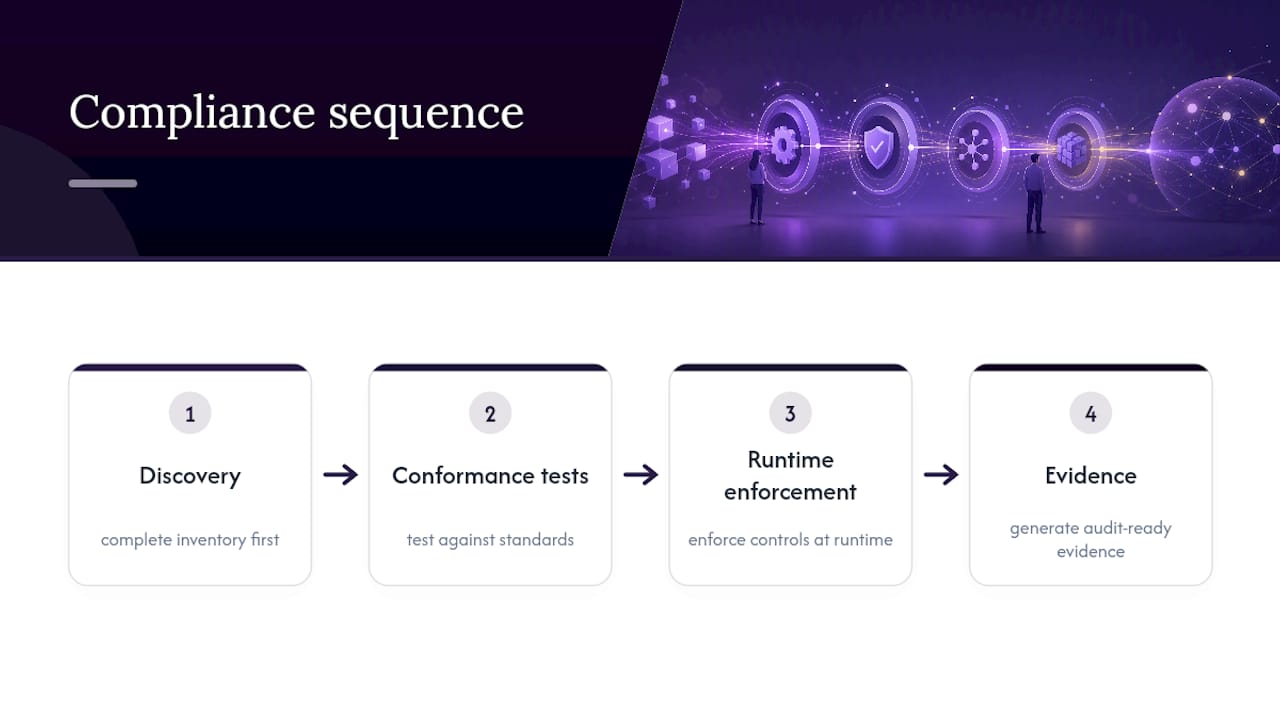
Prioritize by blast radius, not by what’s easiest to fix. Payment APIs, PHI endpoints, and identity services carry the regulatory and reputational weight; a marketing API drifting out of spec is an inconvenience, not a fine.
The real failure mode isn’t under-investing in compliance. It’s building it as a separate system that fights your delivery pipeline instead of running inside it, which is exactly the gap Jundago’s governance layer is built to close.
— vivek
How Jundago Handles Compliance Automation for Regulated APIs
Jundago builds compliance into the API lifecycle itself, so the checklist above isn’t a separate project bolted onto engineering work. API Studio generates REST, GraphQL, gRPC, and SOAP APIs directly from intent, with OpenAPI documentation produced alongside the code rather than written after the fact. EndPlex, the native API workbench with a built-in AI Assistant, handles conformance testing so staging behavior gets checked against production expectations before release, not after an incident. Command Center governs everything across AWS, Azure, GCP, and Oracle Cloud from one place, with RBAC and ABAC security controls and signed evidence reports ready when an auditor asks.
Industry modules already map to PCI DSS, HIPAA and HL7 FHIR, and Open Banking, so teams in fintech and healthcare aren’t starting the regulatory mapping from a blank page. If your team is still stitching together conformance testing, drift detection, and audit evidence across separate tools, a platform built for regulated API work is worth a direct look. Start with a sandbox environment or request a demo to see how your current API inventory maps to the checklist covered here.