Fine Grained Authorization: A Developer's Guide to Implementation
Fine Grained Authorization: A Developer’s Guide to Implementation

Fine grained authorization (FGA) is the practice of granting or denying access to a specific resource, action, or context, rather than a broad role. Instead of “editors can edit documents,” FGA answers “can Alice edit document-42, right now, given her relationship to that document?” That distinction is what makes it the standard for multi-tenant SaaS, per-resource sharing, and AI agents querying private data.
The decision rule is simple. If your permission model is flat, your tenant count is small, and roles map cleanly to job functions, role-based access control (RBAC) still works and costs less to build. The moment you need per-resource sharing, conditional rules based on time or location, or an AI/RAG agent that must only see a narrow slice of a knowledge base, you need ABAC, ReBAC, or a purpose-built FGA layer.
Three things ground this recommendation:
- OAuth 2.0 and JWT already carry the signed claims your policy engine needs to make these decisions trustworthy.
- Relationship-based engines can answer per-action checks in milliseconds when properly indexed, so granularity doesn’t have to cost you latency.
- Platforms like Jundago now ship RBAC and ABAC as native controls, which shortens the path from prototype to a production-grade permission system.
Key Takeaways
Fine-grained authorization succeeds when relationship models, signed attribute sources, and centralized audit logging work together instead of being bolted on separately.
| Point | Details |
|---|---|
| Match the model to the need | Use RBAC for flat, stable roles; move to ABAC or ReBAC once per-resource sharing or AI agents enter the picture. |
| Keep decisions fast | Indexed relationship engines resolve checks in milliseconds, so granularity rarely costs you latency. |
| Treat attributes as perishable | Sign attributes in OAuth2/JWT tokens and build explicit revocation paths to avoid stale permissions. |
| Test policies like code | Run allow/deny unit tests and differential tests in CI before every policy change ships. |
| Jundago bakes it in early | Native RBAC/ABAC and centralized governance in Jundago mean compliance controls exist from API generation, not as a retrofit. |
Table of Contents
- Fine Grained Access Control Models: RBAC, ABAC, and ReBAC
- Architecture for Granular Access Control: PEP, PDP, and Token Flows
- Implementation Patterns for Dynamic Authorization
- Performance and Scale in Access Control Strategies
- Security, Compliance, and AI/RAG Risk
- Rollout Checklist: From Prototype to Production
- How Jundago Supports Fine Grained Authorization in Regulated Systems
- Common Policy Languages and Standards
- Integrating Identity Providers: OAuth, SAML, and OIDC
- Testing and Validating Authorization Policies
- Dynamic Authorization: Context and Time-Based Conditions
- What the Industry Gets Wrong About Fine-Grained Authorization
- Get Fine Grained Authorization Built Into Your APIs From Day One
- Sources
Fine Grained Access Control Models: RBAC, ABAC, and ReBAC
Three models dominate the fine grained access control conversation, and each solves a different shape of problem.
RBAC assigns permissions to roles, and roles to users. It’s fast to reason about and fast to build. It breaks down when you need per-document exceptions, because you end up minting a new role for every edge case, a pattern known as role explosion.
ABAC evaluates attributes of the user, the resource, the request, and the environment. A policy might read: “allow if user.department == resource.owning_department AND request.time is business hours.” ABAC handles nuance RBAC can’t, but every attribute becomes something you must source, secure, and keep fresh.
ReBAC (relationship-based access control) models permissions as a graph of typed resources and relationships: documents belong to folders, folders belong to workspaces, users are members of workspaces. Access flows through these relationships, often expressed as tuples like document:42#viewer@user:alice.
- Typed resources give each object a type (document, folder, workspace) so policies can be written once and reused across every instance of that type.
- Relations define how a user connects to a resource, directly or through inheritance (a workspace member inherits access to its folders).
- Tuples are the stored facts: who has what relation to what resource. They’re the database rows your policy engine actually queries.
- Conditions layer ABAC-style logic on top of a relation, such as “viewer, but only during business hours.”
- Reverse queries answer “what can this user access?” instead of “can this user access this?” and they power every permissioned list view in your UI.
Pro Tip: Model your permissions as a graph before you write a single policy rule. Draw the boxes (users, groups, documents, folders, tenants) and the arrows between them. Most modeling mistakes happen when teams jump straight to code.
Architecture for Granular Access Control: PEP, PDP, and Token Flows
A production fine-grained authorization system splits into two roles you’ll hear constantly: the Policy Enforcement Point (PEP) and the Policy Decision Point (PDP). The PEP sits in your request path, at the API gateway or inside the service itself, and intercepts the call. The PDP holds the actual policy logic and returns an allow or deny decision.

Where you place the PEP matters. Gateway-level enforcement centralizes control and keeps services simple, but it can miss field-level rules that only make sense inside a service’s own data model. Many teams end up running a lightweight PEP in both the gateway and the service layer.
Token design carries real weight here. Signed OAuth 2.0 and JWT claims give the PDP attributes it can trust, since tampering during transport becomes cryptographically detectable.
A few architecture notes worth writing down before you build:
- Keep a single, versioned policy store instead of scattering rules across services.
- Log every decision, not just denials, since auditors want to see what was allowed and why.
- For multi-region deployments, replicate the policy store but keep tenant data partitioned so a lookup never crosses tenant boundaries.
The attribute source has to be a tamper-proof source of truth passed through signed tokens, so the PDP is always evaluating claims that haven’t been altered in transit.
Implementation Patterns for Dynamic Authorization
Modeling starts with naming. Use a consistent typed convention: resource_type:id#relation@subject. A folder-to-document relationship might look like document:42#parent@folder:7, and a user’s access flows through that parent link automatically once you define the inheritance rule.
Reverse queries, the “list everything this user can see” pattern, are usually where teams get stuck. Querying tuples live for every list view doesn’t scale past a few hundred resources. The fix is a materialized index keyed by principal, kept eventually consistent with a bounded staleness window rather than recalculated on every read.
Four patterns cover most of what you’ll actually need to build:
- Delegation and on-behalf-of access: model a separate relation (
delegate) rather than reusingowner, so revoking delegated access never touches the underlying ownership tuple. - Time-limited grants: attach an expiry condition to the tuple itself, and sweep expired tuples on a schedule rather than checking expiry on every read.
- Field-level permissions: when a user can view a record but not every field on it, enforce that at the service layer after the PDP’s coarse allow, not inside the PDP’s own policy language.
- Group-to-resource inheritance: model group membership as its own relation, so adding someone to a group grants access to everything the group already has, with zero new tuples written.
Pro Tip: Don’t try to encode field-level masking inside your authorization policy language. Let the PDP answer “can this user touch this record,” then filter fields in your service response. Mixing the two makes both harder to test.
Performance and Scale in Access Control Strategies
A permission check that runs on every single API call sounds like it should be slow. It usually isn’t. Relationship-based engines can resolve typed-tuple lookups in single-digit milliseconds when the index is built correctly, which is faster than most of the database calls already happening in that same request.
The real cost shows up in cache invalidation. When a tuple changes, anything cached against the old relationship has to be evicted, and getting that propagation wrong is the most common source of stale-permission bugs in production.
A few operational habits keep FGA fast and honest at scale:
- Cache decisions at the PEP with a short TTL, not indefinitely, so revocations propagate within seconds rather than minutes.
- Batch permission checks when rendering a list view instead of issuing one call per row.
- Load-test the PDP under realistic tuple volume, not a toy dataset, since query plans that look fine at 10,000 tuples can degrade badly at 10 million.
- Set an explicit latency SLA for authorization checks (most teams target single-digit milliseconds at p95) and alert when the PDP breaches it.
Security, Compliance, and AI/RAG Risk
Fine-grained authorization is the control that keeps an AI agent from reading things it shouldn’t. As of 2026, organizations running multi-tenant SaaS or AI/RAG pipelines should treat FGA as required, because it limits an agent’s retrieval scope to the exact document slice its calling user is authorized to see, rather than the entire corpus the model was indexed against.
For HIPAA, PCI DSS, and GDPR obligations, the requirement is usually the same: prove who could access what, and when. Centralizing FGA gives you one audit trail instead of a dozen scattered logs, which is the difference between a two-day audit response and a two-week one.
Three controls matter most in practice:
- Make every allow and deny decision immutable and timestamped, not just denials.
- Treat attributes as perishable: short-lived claims and explicit revocation paths stop stale permissions from lingering after a role change.
- Sign every token that carries an attribute, so a compromised network hop can’t quietly grant access it shouldn’t.
Rollout Checklist: From Prototype to Production
Moving fine-grained access control into a live system works best as a staged rollout, not a single cutover.
- Prototype the model with a handful of resource types and relations, and write unit tests against the tuples before touching production traffic.
- Add the PEP and PDP at the gateway or service layer, and instrument every decision with a log line, even in dry-run mode.
- Wire in trusted attribute sources, using signed OAuth2/JWT claims so the PDP never trusts an unverified attribute.
- Run staging load tests at realistic tuple volume and confirm p95 latency holds under your SLA.
- Roll out in phases, tenant by tenant or feature by feature, with monitoring dashboards and an audit-log spot check before the next phase begins.
How Jundago Supports Fine Grained Authorization in Regulated Systems
Jundago maps directly onto the architecture above rather than replacing it. The platform ships native RBAC and ABAC controls, so the PDP-level policy work described earlier doesn’t start from a blank slate. Its governance layer, run from Command Center, gives teams the centralized audit trail that HIPAA, PCI, and GDPR reviews ask for, across AWS, Azure, GCP, and Oracle Cloud deployments.
Where this actually saves time:
- API Studio and GraphQL Studio generate the endpoints and resolvers that need permission checks, with RBAC/ABAC hooks built in rather than bolted on later.
- Industry modules for healthcare, finance, and manufacturing bring the compliance scaffolding (HL7 FHIR, PCI DSS, IEC 62443) into the same governed environment.
- EndPlex’s AI Assistant helps engineers test policy logic against real request patterns before staging load tests.
| Point | Details |
|---|---|
| Governance is centralized | Command Center gives one audit trail across every cloud target instead of four scattered logs. |
| RBAC/ABAC ships native | Permission hooks exist at generation time, not as a retrofit after launch. |
Common Policy Languages and Standards
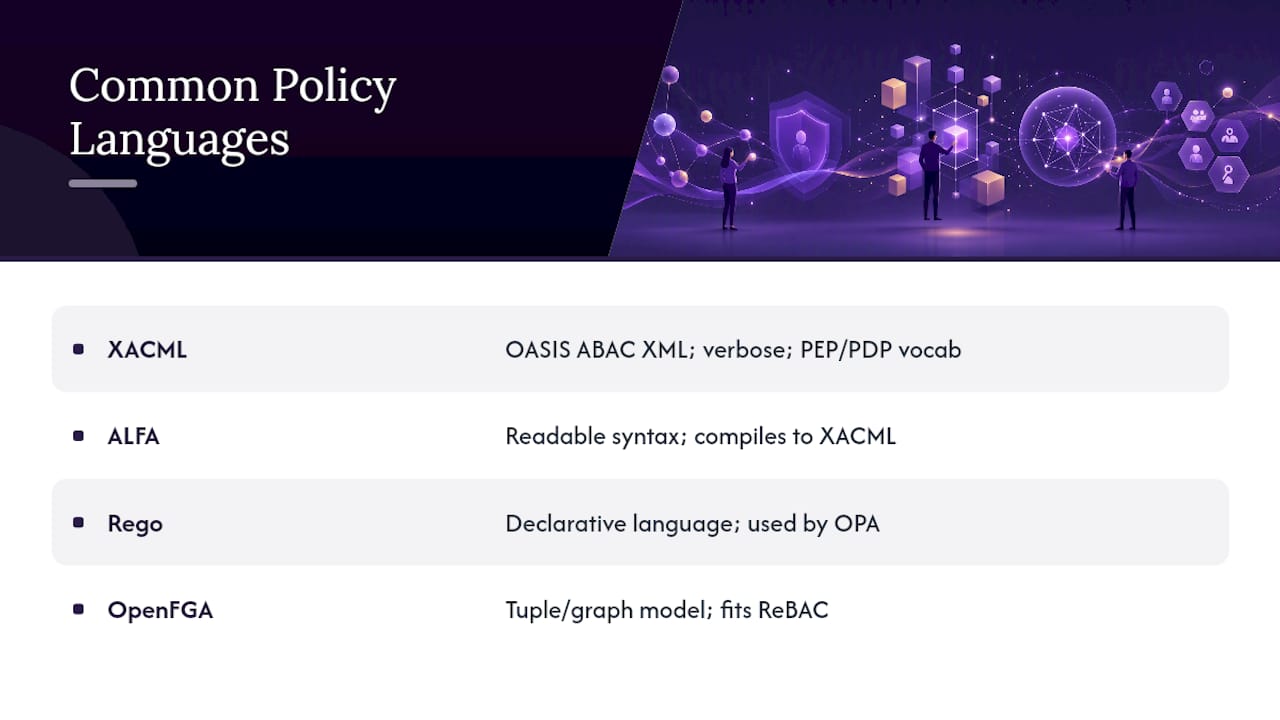
Most teams writing fine-grained rules eventually run into XACML (eXtensible Access Control Markup Language), an OASIS standard for expressing ABAC-style policies in XML. It’s verbose and rarely hand-written today, but it established the PEP/PDP/PAP/PIP vocabulary that nearly every modern authorization system still uses, including the PEP and PDP terms used throughout this guide.
ALFA (Abbreviated Language for Authorization) emerged as a more readable, developer-friendly notation that compiles down to XACML, letting engineers write policies that look closer to code than markup.
Outside the XACML family, several newer approaches have gained real adoption. Rego, the policy language behind Open Policy Agent, expresses rules declaratively and is popular for Kubernetes admission control and general-purpose API policy. Relationship-based systems like OpenFGA use their own tuple-and-model syntax, closer to a graph schema than a traditional policy language, which fits ReBAC’s relationship-first approach better than XACML’s attribute-first design.
There’s no single winning standard right now, and that’s fine. What matters more than the specific syntax is whether your chosen language can express the three things you actually need: role checks, attribute conditions, and relationship traversal. Teams building from scratch usually get further faster with Rego or a relationship-tuple model than with hand-rolled XACML, simply because the tooling and community examples are denser. Teams in heavily regulated industries with existing XACML infrastructure often keep it and layer ABAC conditions on top rather than migrating wholesale.
Integrating Identity Providers: OAuth, SAML, and OIDC
Fine-grained authorization doesn’t replace your identity provider. It consumes what your IdP already knows and adds a second, more granular decision on top of it.
OAuth 2.0 handles delegated access and issues the access tokens your PEP intercepts at the gateway. OIDC (OpenID Connect) builds on OAuth to add identity claims, giving you a verified user identity alongside the access grant. SAML still shows up heavily in enterprise single sign-on, particularly in finance and healthcare, and typically hands off to OAuth/OIDC once inside the API layer.
The integration pattern that works best in practice: let the IdP handle authentication and issue a signed token carrying basic identity claims (user ID, tenant ID, group memberships), then let your PDP layer relationship and attribute checks on top of those claims rather than trying to cram fine-grained rules into the identity token itself. Overloading a SAML assertion or OIDC ID token with dozens of custom claims makes token size balloon and couples your IdP configuration to every policy change you make later.
A cleaner split: identity claims live in the token, relationship and resource-level facts live in your policy store, and the PDP joins the two at decision time. This keeps your IdP swappable, a real concern for enterprises that migrate identity providers every few years without wanting to rewrite their entire permission model.
Testing and Validating Authorization Policies
Authorization bugs are uniquely dangerous because they fail silently. A broken policy doesn’t crash your app; it just lets the wrong person see the wrong document, and nobody notices until an audit or a support ticket surfaces it.
Unit testing policies means writing explicit allow and deny assertions for every relation type before you ship a model change. If document:42#viewer@user:alice should resolve true and document:42#viewer@user:bob should resolve false, both need a test, and both need to run in CI on every policy change.
Beyond unit tests, three practices catch what unit tests miss:
- Contract tests between PEP and PDP verify that the enforcement point is actually calling the decision point with the right request shape, since a malformed check that always returns “allow” is worse than no check at all.
- Differential testing runs the old and new policy version against the same request set before a rollout, flagging any decision that flipped unexpectedly.
- Chaos-style negative testing deliberately sends malformed or expired tokens to confirm the PDP fails closed, denying access, rather than failing open.
Treat your policy test suite the same way you’d treat a database migration test suite: something that blocks a deploy if it fails, not something that runs occasionally as a sanity check.
Dynamic Authorization: Context and Time-Based Conditions
Static permissions answer “can this role touch this resource.” Dynamic authorization answers a harder question: “can this specific user touch this specific resource right now, given where they are, what device they’re on, and what’s happened in the last five minutes.”
Context-aware conditions layer on top of your existing relation checks. A support engineer might have viewer access to customer records generally, but a condition restricts that to business hours and a corporate IP range. Time-based conditions expire a grant automatically, useful for contractor access or incident-response elevation that should never quietly become permanent.
The hard part isn’t expressing these conditions. It’s keeping the underlying attributes fresh enough that the condition means something. A location attribute that updates once a day is useless for a policy meant to enforce real-time geofencing. This is where attribute lifecycle management becomes a genuine engineering problem rather than a policy-writing exercise: someone has to own the pipeline that keeps device posture, location, and session risk scores current.
A practical rule: only add a dynamic condition if you can name the system that will keep its underlying attribute fresh, and how often it updates. A condition backed by a stale or unowned attribute is a false sense of security, arguably worse than not having the condition at all.
What the Industry Gets Wrong About Fine-Grained Authorization
Most teams treat fine-grained authorization as a feature to bolt on once the product is stable. That ordering is backward. Permission models get harder to change the more resources and relationships accumulate around them, and retrofitting ReBAC onto a system built on ad hoc role checks is close to a rewrite, not a migration.
The conventional advice, “start simple with RBAC, add complexity later,” is directionally right but usually applied too late. The better version: start with RBAC, but design your resource schema as if relationships were coming, even before you build the ReBAC layer. Name your resources with types from day one. Model group membership as a relation, not a database join, even while you’re still enforcing access with role checks. That schema discipline is what makes the eventual migration to ABAC or ReBAC a policy change instead of a data migration.
The other overrated idea is that dynamic, context-aware conditions are inherently more secure than static role checks. A time-based or location-based condition backed by a stale attribute pipeline is theater. It looks precise on a policy diagram and fails exactly when you need it to hold.
Prioritize the attribute pipeline before the clever policy logic. A boring, reliable source of truth for who belongs to what group beats an elegant conditional rule running on data that’s twelve hours old.
— vivek
Get Fine Grained Authorization Built Into Your APIs From Day One
Jundago gives regulated enterprises a faster path to the architecture this guide just walked through, RBAC and ABAC controls, audit trails, and governance are already built into how APIs get generated, not added after the fact. Instead of standing up a separate policy store, wiring a PEP by hand, and hoping your compliance team signs off later, API Studio and GraphQL Studio generate REST, GraphQL, gRPC, and SOAP APIs with those controls present from the first commit.
That matters most for teams in healthcare, finance, or manufacturing, where HIPAA, PCI DSS, and IEC 62443 requirements make retrofitting authorization a compliance risk, not just an engineering cost. Command Center governs all of it across AWS, Azure, GCP, and Oracle Cloud, so tenant isolation and audit logging stay consistent no matter where the API runs.
If the rollout checklist above looks like a multi-quarter project on your current stack, see how Jundago’s platform handles API generation, testing, and governance together, and get a demo scoped to your compliance requirements.
Sources
- What is Fine-Grained Authorization? (OpenFGA docs)
- How to implement attribute-based access control for APIs (Nordic APIs)
- OAuth2 / JWT guidance (Ping Identity docs)
- Fine-grained access control (Okta)