KYC AML Integration: An API-First Approach for Banks
KYC AML Integration: An API-First Approach for Banks

Integrate KYC as an API-driven identity layer orchestrated into your AML screening and monitoring platform. Start by scoping which checks apply to which products and jurisdictions, mapping your customer data model, and standing up an orchestration layer that connects identity verification to sanctions and PEP screening in real time.
Done right, KYC AML integration gives you three things at once: a regulator-ready audit trail, fewer false-positive alerts clogging your review queue, and onboarding that finishes in minutes instead of days.
Your next move isn’t picking a vendor. It’s mapping the customer journey and data fields you already have, then deciding where verified identity data needs to flow into your AML rules engine.
- Scope checks by product line and jurisdiction before writing a single integration spec.
- Map the canonical customer data model: identity attributes, UBO structure, and risk score fields.
- Stand up an orchestration layer connecting KYC outputs directly to AML screening.
Financial institutions that automate this handoff between identity verification and AML screening pipelines cut manual review time and produce a cleaner evidentiary record when examiners come asking for it.
TL;DR:
- Map customer data fields and scope checks by product and jurisdiction before designing API integrations, to ensure regulatory compliance and operational fit.
- Use a canonical customer record capturing documents, UBO structure, and verification outcomes to facilitate audit trails and maintain consistent data flow.
- Automate the handoff between KYC verification and AML screening with an orchestration layer that connects outputs directly to risk rules, reducing manual reviews and false positives.
- Build an API-first, event-driven architecture with idempotent webhooks and explicit SLAs to handle latency and retries, especially for real-time transaction monitoring.
- Continuously improve rules and thresholds based on feedback from alert outcomes, rather than treating initial configurations as fixed, to reduce false alarms and adapt to jurisdictional differences.
Table of Contents
- What Is the Difference Between KYC and AML?
- Why Does Integrating KYC Into AML Operations Matter?
- How Do You Architect KYC AML API Integration?
- What Regulatory Requirements Should Drive Your Design?
- What Belongs on Your Implementation Checklist?
- How Should You Handle Ongoing Monitoring and Alerts?
- What Integration Mistakes Should You Avoid?
- What Compliance Teams Get Wrong About KYC AML Integration
- How Jundago Supports API-First KYC AML Integration
- Key Takeaways
- Where to Go for Regulatory Detail
- Sources
What Is the Difference Between KYC and AML?
KYC and AML solve different problems, even though most people use the terms interchangeably. Know Your Customer (KYC) verifies who someone is: identity documents, proof-of-address, and for businesses, Know Your Business (KYB) checks that unwind the ownership structure down to the ultimate beneficial owners (UBOs). Anti-Money Laundering (AML) is the broader program that watches what customers do after onboarding: transaction monitoring, sanctions and politically exposed person (PEP) screening, and suspicious activity reporting.
KYC is a point-in-time gate. AML is a continuous process that never really stops.
- KYC produces verified identity, a risk score, and UBO data at onboarding.
- AML consumes those outputs to calibrate transaction monitoring thresholds and screening frequency.
- A weak KYC process means your AML engine is making risk decisions on bad inputs.
That last point gets missed constantly. Institutions troubleshoot alert fatigue in the AML layer when the real defect sits upstream in identity verification.
Why Does Integrating KYC Into AML Operations Matter?
Treating KYC and AML as separate systems creates duplicate work. Analysts re-key the same customer data into two platforms, verification outcomes go stale before they reach the monitoring engine, and every gap between systems is a gap an examiner will find.
Integration collapses that gap. A verified identity and its risk score feed directly into monitoring rules, which means:
- Fewer duplicate manual reviews and fewer false positives triggered by mismatched customer records.
- An onboarding flow that produces its own audit trail automatically, satisfying regulators without extra paperwork.
- Lower operating cost per account opened, since automated AML checks replace manual cross-referencing.
The customer experience improves too. Automated identity checks that hand off cleanly to screening mean legitimate customers clear onboarding in minutes rather than waiting on a queue built for manual reconciliation.
How Do You Architect KYC AML API Integration?
Three architectural decisions determine whether your KYC AML API integration holds up under regulatory scrutiny and transaction volume.
- API-first design. Connect a dedicated identity verification API to sanctions and PEP screening connectors through a central orchestration or workflow engine. This keeps each capability swappable and testable in isolation, rather than hardwiring vendor logic into your core banking system.
- Event-driven processing. Use webhooks and message queues instead of polling. Build every handler to be idempotent, since the same screening result can arrive twice during retries, and a duplicate case record is worse than a missed one.
- A canonical identity record. Every customer needs one auditable object holding documents, the resolved UBO tree, verification outcomes, and full screening history. This is what your monitoring engine, and later your examiner, actually queries.
Latency matters more than most teams plan for. A sanctions screen that takes eight seconds is fine for account opening; the same eight seconds inside a real-time payment rail is not. Set explicit service-level agreements per checkpoint, and validate every flow in a sandbox with staged credentials before it touches production.
Pro Tip: Test your sandbox environment with synthetic UBO structures that include at least one deliberate sanctions hit. If your orchestration layer can’t correctly escalate a planted bad actor, it won’t catch a real one either.
What Regulatory Requirements Should Drive Your Design?
Regulatory mapping isn’t a compliance afterthought bolted onto the architecture. It should be the architecture.
- Customer due diligence (CDD). FinCEN’s CDD final rule requires covered institutions to identify and verify beneficial owners and retain records of that verification process. Your canonical identity record needs to store exactly what that verification consisted of, not just its outcome.
- Sanctions screening. OFAC maintains the sanctions lists your screening pipeline checks against, and those lists update on no fixed schedule. Screening frequency needs to reflect that unpredictability, not a quarterly batch job.
- Risk-based monitoring. FATF’s recommendations call for a risk-based approach to ongoing monitoring rather than uniform rules applied to every customer equally.
- Recordkeeping. Bank Secrecy Act obligations enforced through IRS guidance tie directly into how long and how completely you retain verification and monitoring records.
Build configurability into thresholds and required checks from day one. A rule that works for a retail deposit account in one jurisdiction will be wrong for a correspondent banking relationship in another.
What Belongs on Your Implementation Checklist?
Sequence matters more than completeness here. Skipping ahead to integration before scoping is the single most common way teams end up rebuilding six months later.
- Define risk appetite and scope. Decide which products and jurisdictions this integration covers before writing any code.
- Map your data model. Nail down canonical identity fields and UBO ownership thresholds (a common ownership threshold, though this varies by jurisdiction and product).
- Choose your integration path. A hosted verification widget is fastest to launch; a direct API integration gives more control; a full orchestration layer gives you both, at higher upfront engineering cost.
- Build for operational resilience. Reliable webhook delivery, automatic retries, and immutable audit logs aren’t optional extras.
- Test in layers. Sandbox validation, staging smoke tests, and policy acceptance tests that confirm your rules actually fire the way compliance intended.
- Govern access. Role-based (RBAC) and attribute-based (ABAC) access controls, a defined cadence for policy review, and training for the analysts who’ll handle manual escalations.
Pro Tip: Run your policy acceptance tests with actual compliance staff in the room, not just engineers. A rule that passes every unit test can still misfire against a real-world risk scenario nobody coded for.
How Should You Handle Ongoing Monitoring and Alerts?
Integration doesn’t end at go-live. AML monitoring is only as good as its feedback loop.
- Set a re-screening cadence for existing customers against updated watchlists, not just new customers at onboarding.
- Define a clear triage path for every alert: enrich, review, escalate, or close, with each step logged to an immutable audit trail.
- Track time-to-decision, false-positive rate, and alerts per full-time analyst as your core operating metrics.
- Feed closed-alert outcomes back into your rules engine to cut recurring noise from patterns that keep resolving as false positives.
Institutions that skip that last step tend to see alert volume climb every quarter with no corresponding rise in actual detections, a sign the rules need retuning rather than more headcount.
What Integration Mistakes Should You Avoid?
- Weak auditability. Mutable case records won’t survive an examination. Use tamper-evident logs and immutable case objects instead.
- Brittle webhooks. A dropped delivery shouldn’t mean a missed screening result. Use idempotency keys and queued delivery with dead-letter handling for failures.
- One-size-fits-all rules. A single global threshold ignores how differently jurisdictions and product lines carry risk. Build per-segment configurability from the start.
What Compliance Teams Get Wrong About KYC AML Integration
Most guidance on this topic treats KYC AML integration as a procurement decision: pick the right vendor, plug it in, done. That framing undersells the actual work. The hard part isn’t connecting an API. It’s deciding, before any code gets written, what your canonical identity record looks like and which fields your AML rules actually need to see.
I’d also push back on the instinct to over-engineer for every edge case on day one. Teams that try to build jurisdiction-perfect rules before launch often ship nothing for a year. The better sequence is narrow scope, working orchestration, then expand jurisdiction by jurisdiction with real data informing each threshold.
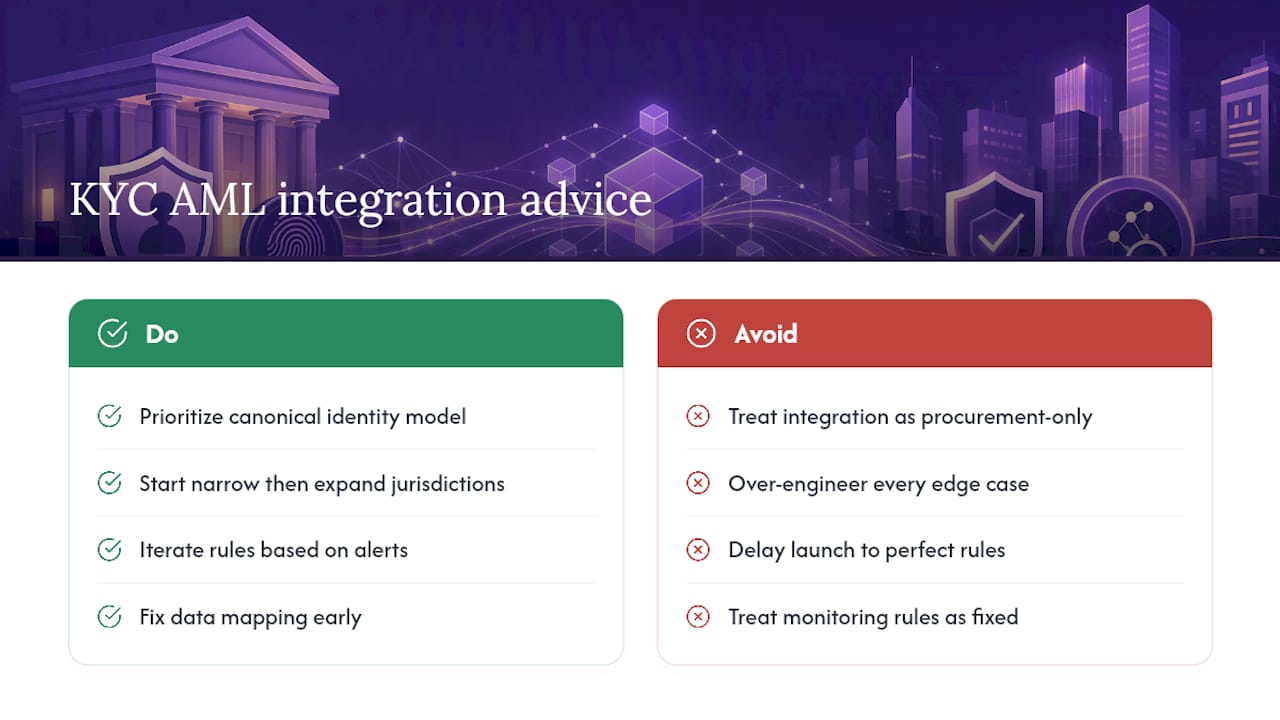
The most overlooked piece is the feedback loop between closed alerts and rule tuning. Institutions invest heavily in the initial integration, then treat the monitoring rules as fixed once they’re live. That’s backwards. The rules should be the thing you iterate on most, because false-positive rates that don’t improve over time are usually a sign of a data mapping problem from the original integration, not a monitoring problem.
Prioritize the canonical identity model first. Everything else, screening vendors, orchestration tools, dashboards, is replaceable. Bad data architecture at the identity layer is not.
— vivek
How Jundago Supports API-First KYC AML Integration
Jundago is built for exactly the architecture this article describes: an API-first orchestration layer sitting between identity verification and AML screening, with governance baked in rather than bolted on afterward.
API Studio generates the identity verification and screening-connector APIs from a natural-language specification, which shortens the gap between “we scoped this integration” and “we have a working sandbox.” GraphQL Studio designs the graph layer with AI resolvers when you need a single query surface across identity, UBO, and screening data instead of stitching together multiple REST calls. EndPlex, the native API workbench, gives engineering teams an AI assistant for building and debugging the orchestration logic itself, while Command Center governs the whole stack across AWS, Azure, GCP, or Oracle Cloud with RBAC and ABAC controls already configured for regulated environments.
For teams handling KYB and beneficial ownership resolution, Jundago’s ETL/ELT integration studio handles the data mapping between core banking systems and your canonical identity record without custom scripts on both ends. The finance-specific compliance modules cover PCI DSS and Open Banking requirements alongside KYC/AML, so the sandbox you test in reflects the controls you’ll actually need in production.

A practical starting point: pilot the orchestration layer against a single product line and jurisdiction, validate the canonical identity model end to end, then expand. Visit Jundago to see how the platform maps to your existing KYC and AML stack.
Key Takeaways
Effective KYC AML integration depends on a canonical, auditable identity record feeding a risk-based AML monitoring engine through API-driven orchestration.
| Point | Details |
|---|---|
| Start with scoping, not vendors | Define risk appetite, product lines, and jurisdictions before selecting any integration path. |
| Build one canonical identity record | Store documents, UBO trees, and screening history together for full audit context. |
| Design for regulatory mapping | Tie CDD, sanctions screening, and FATF risk-based monitoring directly to technical controls. |
| Treat monitoring as iterative | Feed closed-alert outcomes back into rules to reduce recurring false positives. |
| Consider an AI-native platform | Jundago’s API Studio, EndPlex, and Command Center support API-first orchestration with built-in governance for regulated environments. |
Where to Go for Regulatory Detail
- FinCEN’s CDD final rule for beneficial ownership verification requirements.
- FATF recommendations for risk-based AML program design.
- OFAC sanctions programs for screening list sources.
These are starting points. Jurisdiction-specific interpretation still requires legal counsel familiar with your market.
This article is general information, not a substitute for advice from a qualified financial advisor. Consult a qualified financial professional about your own circumstances before acting on anything here.
Sources
- FinCEN — CDD final rule
- FATF — Recommendations
- U.S. Treasury — OFAC sanctions programs and information