AI Assisted Multi Cloud API Management for Regulated Enterprises
AI Assisted Multi Cloud API Management for Regulated Enterprises

Multi-cloud API management works best as a centralized control plane paired with federated, self-hosted gateways and policy-as-code baked into every deployment. That combination lets regulated enterprises govern security and compliance from one place while running gateways close to the workloads in AWS, Azure, GCP, or Oracle Cloud. It suits any team that needs consistent audit trails across clouds without sacrificing latency or resilience.
TL;DR:
- A multi-cloud API management strategy should use a centralized control plane with federated gateways to maintain security, compliance, and policy consistency across clouds.
- Hybrid, multi-cloud, and hybrid-multicloud patterns differ in complexity, with the latter offering more flexibility but also higher operational overhead, suitable mainly for regulated environments.
- Key features for effective platforms include policy enforcement, RBAC and ABAC, token and mTLS security, schema validation, and cross-cloud observability; testing audit trails before deployment is critical.
- Common failure points include configuration drift, identity sprawl, and latency issues, which can be mitigated by automating configurations, federating identities, and deploying regional gateways.
- Prioritize governance and compliance first, automate policy and testing, then expand gradually through pilots to ensure reliable multi-cloud API management.
Table of Contents
- What Is Multi-Cloud API Management, Exactly?
- Hybrid vs. Multi-Cloud vs. Hybrid-Multicloud: Which Pattern Fits?
- What Features Should You Require From a Multi-Cloud API Platform?
- Where Multi-Cloud API Deployments Break, and How to Fix It
- A Prioritized Checklist for Getting Multi-Cloud API Management Right
- How Do You Actually Roll This Out Step by Step?
- Why an AI-Enabled, Compliance-First Platform Changes the Math
- What Should You Actually Prioritize First?
- Putting Jundago’s Checklist Mapping to Work
- Sources
What Is Multi-Cloud API Management, Exactly?
Multi-cloud API management is the practice of designing, securing, and monitoring APIs across more than one cloud provider through a single governance layer. It differs from simple hybrid cloud setups because the goal isn’t just connecting on-premises systems to one cloud. It’s making policy, identity, and observability behave identically whether a request lands in AWS, Azure, or Oracle Cloud Infrastructure.
The architecture splits into two layers. The control plane holds policy definitions, API contracts, RBAC and ABAC rules, and the developer portal. The data plane is where the actual traffic flows through gateways deployed near the workloads themselves. Azure API Management documents this split directly, supporting self-hosted, containerized gateways that stay under a centralized policy authority even when the gateway itself runs outside Azure.
A few components make this model function day to day:
- An API registry that catalogs every endpoint, its owner, version, and compliance status across clouds.
- Self-hosted or containerized gateways deployed in each cloud or region, enforcing policy locally but reporting back centrally.
- CI/CD pipelines that treat gateway configuration and policy files as code, not manual console changes.
- Infrastructure-as-code templates (Terraform, Pulumi, Bicep) that guarantee the same gateway configuration lands identically in every environment.
Design the control plane’s API as a fixed contract that runtimes validate against. That prevents policy authors and actual gateway behavior from drifting apart, which is one of the most common failure modes in distributed API estates.
Hybrid vs. Multi-Cloud vs. Hybrid-Multicloud: Which Pattern Fits?
Picking the wrong deployment pattern is the single most expensive mistake teams make early on, because migrating gateway architecture later means touching every consuming application. Three patterns cover almost every regulated enterprise scenario.
- Hybrid cloud API management connects on-premises systems (often legacy core banking or hospital record systems) to one public cloud. Choose this when data residency law requires certain records to stay on-premises but you still want cloud-native developer tooling.
- Multi-cloud API management runs workloads across two or more public clouds without an on-premises component. Choose this when you’re avoiding vendor lock-in or need best-of-breed services. Gartner’s research on multicloud adoption points to resilience and cost optimization as the leading drivers, not just avoiding a single vendor’s outages.
- Hybrid-multicloud blends both: on-premises systems, plus two or more public clouds, unified under one control plane. This is common in finance and healthcare, where legacy mainframes coexist with newer AI workloads running in GCP or Azure.
The trade-offs differ sharply by pattern. Hybrid setups minimize data movement but add network latency between on-premises and cloud gateways. Multi-cloud setups improve resilience since an outage in one provider doesn’t take down the whole estate, but they multiply the identity and networking configurations you must keep synchronized. Hybrid-multicloud gives you the most flexibility and the highest operational overhead. Oracle’s documentation on multicloud API gateways walks through concrete patterns for network peering and identity federation across providers, which is worth reviewing before committing to an architecture.
If you’re starting from scratch, pick hybrid-multicloud only if you already have a clear compliance driver forcing it. Otherwise start with a single cloud plus a portable gateway layer, then expand.
What Features Should You Require From a Multi-Cloud API Platform?
A platform that looks capable in a demo can still fail your compliance audit six months in. Evaluate against a specific list, not a vendor’s slide deck.
- Centralized policy management with distributed enforcement. Policies get authored once and pushed to every gateway, regardless of cloud.
- RBAC and ABAC together, not just one. Role-based access covers broad job functions; attribute-based access handles finer conditions like data classification or geography.
- Token management and mTLS between every gateway and backend service, not just at the edge.
- Policy-as-code and schema validation so a bad configuration fails in a pull request, not in production.
- Immutable audit trails that satisfy HIPAA, PCI DSS, or Open Banking auditors without manual log stitching.
- Cross-cloud observability: traces, metrics, and logs unified in one view, not three separate cloud consoles.
- A developer portal with interactive docs so internal teams and partners can discover and test APIs without opening a ticket.
Pro Tip: Test your platform’s audit trail by simulating a failed compliance check on purpose. If you can’t reconstruct exactly which policy blocked the request and why within five minutes, your observability setup has a gap worth fixing before an actual auditor finds it.
Extensible, open runtimes matter more than they get credit for. Apache APISIX demonstrates how WASM extensions and plugin architectures let you customize gateway behavior without forking or replacing the gateway itself, which keeps you portable across cloud vendors as pricing or capabilities shift.
Where Multi-Cloud API Deployments Break, and How to Fix It
Most multi-cloud incidents trace back to one of five recurring failure patterns, and each has a known mitigation.
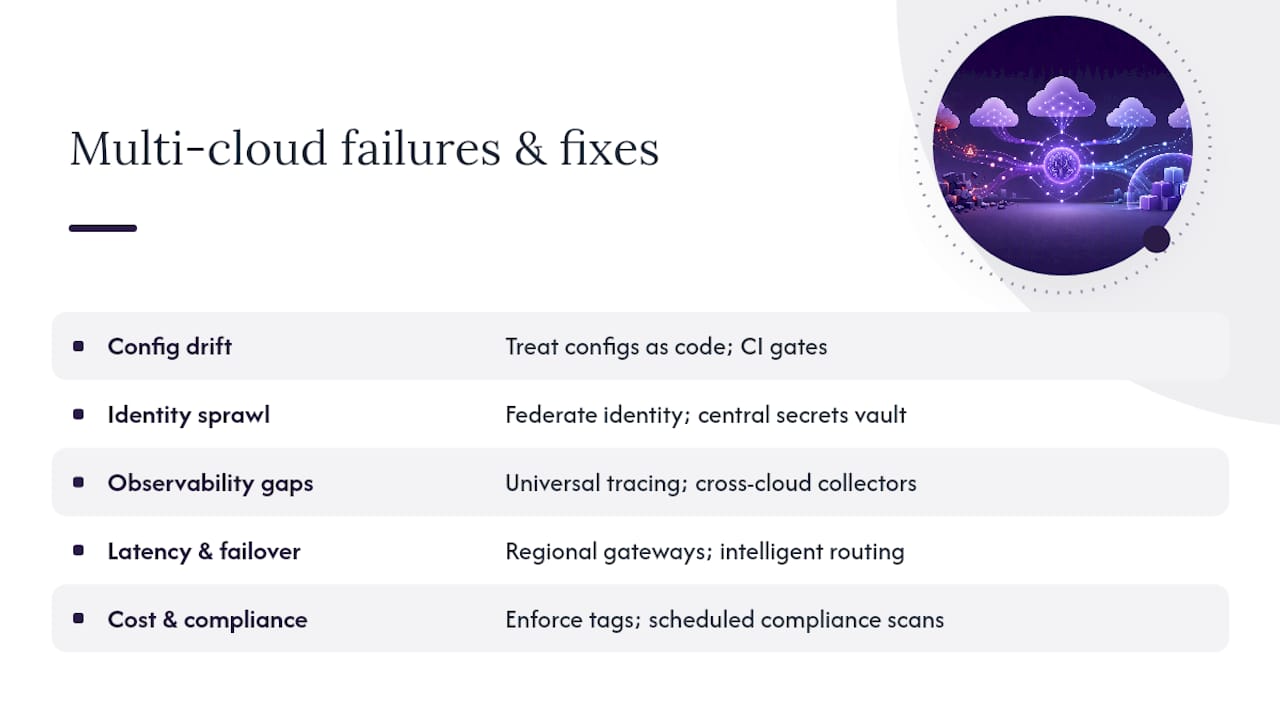
Configuration drift happens when one team edits a gateway policy directly in a console while another relies on the version in source control. Fix it by treating every gateway configuration as code, with CI gates that block manual changes from persisting past the next deployment. Community reference implementations show this working through provider adapters that route policy changes through the same pipeline regardless of target cloud.
Identity sprawl creeps in as each cloud accumulates its own service accounts and secrets stores. Federated identity through a tool like Keycloak, backed by a centralized secrets vault, collapses that sprawl into one auditable source of truth.
Observability blind spots appear at the seams between clouds, where a trace started in AWS loses context entering Azure. Universal tracing standards and cross-cloud collectors close that gap.
Latency and failover problems surface when a single control plane routes every request through one region. Deploy regional gateways with intelligent routing so failover doesn’t add a cross-continent hop mid-outage.
Cost and compliance surprises stem from untagged resources and undocumented services. Enforce tagging policies and run automated compliance scans on a schedule, not just before an audit. Pricing considerations for managed versus self-hosted gateways vary enough between providers that an untracked resource can quietly double a monthly bill.
A Prioritized Checklist for Getting Multi-Cloud API Management Right
Sequencing matters more than completeness here. Teams that try to solve everything simultaneously usually stall before shipping anything.
- Stand up a centralized control plane with a minimal API registry covering your highest-risk APIs first.
- Containerize your gateways and build infrastructure-as-code templates before deploying to a second cloud.
- Implement policy-as-code with automated tests in your existing CI/CD pipeline.
- Set up cross-cloud observability and define service-level objectives before, not after, your first incident.
- Pilot one representative API, measure against your SLOs, then expand only once that pilot clears its gates.
| Priority | Action | Success Signal |
|---|---|---|
| 1 | Centralized control plane + registry | Every API has one authoritative owner and policy source |
| 2 | Containerized, IaC-defined gateways | Identical gateway config deploys across clouds without manual steps |
| 3 | Policy-as-code in CI/CD | Policy violations fail in pull requests, not production |
| 4 | Cross-cloud observability | One trace follows a request across every cloud boundary |
| 5 | Pilot and measured expansion | Pilot API meets latency and compliance SLOs before scaling |
How Do You Actually Roll This Out Step by Step?
A roadmap only works if each phase has a clear exit condition. Here’s the sequence that holds up across healthcare, finance, and manufacturing deployments alike.
- Assessment. Classify every existing API by data sensitivity, regulatory scope, and current cloud location. This tells you which APIs need hybrid patterns and which can move freely.
- Design. Choose your control-plane model, decide which gateways run self-hosted versus managed, and map out identity federation and network connectivity between clouds.
- Build. Write IaC templates for gateway deployment, wire policy-as-code into CI/CD, and build test suites that validate schema and security policy before merge.
- Pilot. Run one non-critical but representative API through the full stack. Practical guidance on multicloud gateway rollouts recommends validating latency, observability, and compliance mechanics here, before touching anything business-critical.
- Rollout and operate. Move to staging, then canary a small percentage of production traffic, with a documented rollback runbook ready before you flip the switch.
Pro Tip: Write the rollback runbook before the pilot, not after. Teams that draft rollback steps only once something breaks lose the time advantage that makes canary deployments useful in the first place.
Why an AI-Enabled, Compliance-First Platform Changes the Math
Retrofitting compliance onto an existing API estate is slower and riskier than building it in from generation. AI-assisted API generation checks policy and schema compliance the moment an API is created, not months later during an audit scramble.
This matters most in integration-heavy environments. Regulated enterprises routinely need EDI integrations, database-to-API and API-to-database connections, and full ETL/ELT pipelines that move data between legacy systems and modern services without breaking compliance boundaries. Each of those integration points is a place where manual configuration historically introduced errors.
A platform built around this problem typically bundles:
- RBAC and ABAC security controls applied consistently across every generated API, not configured separately per endpoint.
- Immutable audit trails generated automatically alongside the API itself.
- Industry-specific compliance modules, such as HIPAA and HL7 FHIR for healthcare or PCI DSS and KYC/AML for finance.
- A native workbench for testing, debugging, and load testing before anything reaches production.
Jundago was built around exactly this model, generating REST, GraphQL, gRPC, and SOAP APIs with compliance controls attached from the start rather than bolted on afterward.
What Should You Actually Prioritize First?
Governance, speed, and cost pull in different directions, and pretending otherwise leads to platforms that satisfy none of the three. My honest read: governance should win every tie-break in a regulated environment, because the cost of a compliance failure dwarfs the cost of a slower rollout.
That said, speed isn’t optional either. Favor platform automation over bespoke tooling whenever your APIs touch more than one regulatory framework. Custom-built compliance checks age badly the moment a regulation changes. A single practical recommendation: before evaluating any platform, write down your three most painful past compliance incidents and test candidate platforms against exactly those scenarios, not a generic feature list.
— vivek
Putting Jundago’s Checklist Mapping to Work
Every capability covered above maps directly onto how Jundago is built. API Studio generates REST, GraphQL, gRPC, and SOAP APIs from plain-language intent, with compliance checks running at generation time instead of after deployment. Command Center acts as the centralized control plane governing policy across AWS, Azure, GCP, and Oracle Cloud simultaneously. EndPlex gives your team a native workbench with an AI assistant for testing and debugging before anything ships. RBAC and ABAC controls, plus EDI, API-to-API, and DB-to-API integrations with full ETL/ELT support, come standard rather than as add-ons.
If you’re evaluating platforms, the fastest way to know if this fits is a focused proof of concept: pick one representative API from your compliance checklist, run it through generation, testing, and deployment across two clouds, and measure the result against your own audit requirements. Start that evaluation on the Jundago platform and see how many of your checklist items it clears in the first pass.