28 OPC UA Services to Expose a Governed REST for Regulated Enterprises
28 OPC UA Services to Expose a Governed REST for Regulated Enterprises

Check whether your OPC UA server ships the OPC Foundation’s standardized WebApi binding first. If it does, enable it and pull the OpenAPI spec instead of building anything custom. If it doesn’t, deploy a gateway that preserves OPC UA’s security model and subscription semantics rather than flattening everything into simple polling. Either way, your first move is the same: look for opc.ua.openapi.allservices.json on the server, or confirm gateway support for it.
TL;DR:
- The standardized WebApi support in OPC UA servers is crucial for seamless integration and should be enabled before deploying custom solutions.
- The OPC Foundation’s OpenAPI mapping covers 28 core services with JSON POST requests, but excludes node management and query, limiting use for dynamic address space modifications.
- Native REST bindings in OPC UA run within the server process, offering high fidelity and simplicity, while gateways provide flexibility for multi-server setups and data transformation.
- Maintaining OPC UA security involves proper token validation, mutual TLS, and role mapping, avoiding the common mistake of disabling security controls for easier REST access.
- For regulated environments, use governance platforms to generate, test, and enforce RBAC and ABAC policies across APIs, ensuring compliance and consistent security at scale.
Table of Contents
- What “OPC UA to REST” Actually Means
- What the OPC Foundation’s OpenAPI Mapping Actually Exposes
- How the REST Binding Works in a Real .NET Deployment
- Gateway Patterns When You Can’t Use the Native Binding
- Mapping OPC UA Security to Web Authentication
- Rolling Out OPC UA to REST in Production
- Choosing Between Native Binding, Gateway, or a Managed Platform
- How Jundago Approaches OPC UA-to-REST for Regulated Enterprises
- What Trips Up Most OPC UA to REST Projects
- Get a Governed REST Front End for Your OPC UA Data
- Sources
What “OPC UA to REST” Actually Means
Converting OPC UA to REST is not one thing. It’s two distinct architectural choices with different failure modes, and picking the wrong one costs you months of rework later.
The first option is a native REST binding, where the OPC UA server itself exposes a standardized OpenAPI surface. Every service call maps directly to a spec-defined route, and the information model, data types, and status codes travel through mostly unchanged. The second option is a gateway or proxy, a separate piece of software that sits between the OPC UA server and REST clients, translating requests and often reshaping the data along the way.
The trade-offs come down to three things:
- Fidelity to the OPC UA information model — a native binding preserves node structure, type definitions, and BrowseNames exactly; a gateway often simplifies or aggregates them, which can break clients expecting the original model.
- Push versus pull semantics — OPC UA subscriptions are inherently push-based; REST is naturally pull-based, so both binding and gateway approaches have to translate publish/notify cycles into either polling endpoints or a streaming layer like Server-Sent Events.
- Performance and scaling — a native binding running in-process with the OPC UA stack avoids an extra network hop; a gateway adds latency but can aggregate multiple servers behind one API, which a single binding cannot do.
REST fits cloud dashboards, mobile apps, and short-lived clients that connect, read a value, and disconnect. Binary OPC UA still wins for closed-loop control, high-frequency telemetry, and anything where sub-second push latency actually matters. Most industrial deployments end up running both side by side, not choosing one over the other.
What the OPC Foundation’s OpenAPI Mapping Actually Exposes
The OPC Foundation didn’t leave REST mapping to guesswork. It’s formally specified, and that specification tells you exactly what you get and, more importantly, what you don’t.
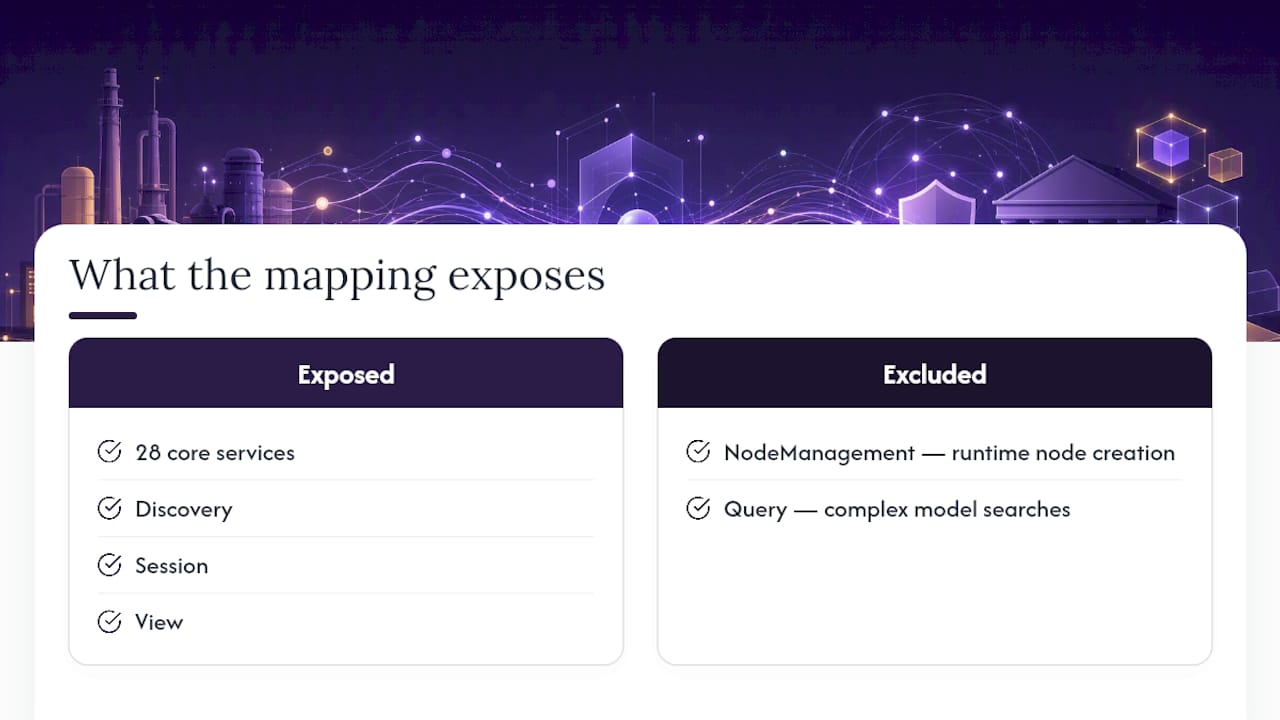
The mapping defined in OPC UA Part 6 §G.3 (version 1.05.07) implements 28 core services spanning discovery, session, view, attribute, method, monitoredItem, and subscription. NodeManagement and Query are explicitly excluded.
That exclusion matters more than it sounds. If your integration depends on runtime node creation, dynamic address space edits, or complex Query-based searches across the information model, the standardized REST mapping won’t cover it. You’ll need to fall back to the binary protocol for those specific operations, or handle them through a separate administrative channel. For read/write/subscribe workloads, which cover the overwhelming majority of dashboard, historian, and cloud-integration use cases, the 28 core services in Part 6 §G.3 are enough.
Every route in the mapping is a POST request exchanging JSON bodies, even for what would normally be a “read” operation in REST convention. That’s a deliberate design choice: OPC UA services carry structured request objects (node IDs, attribute IDs, timestamps, diagnostics flags), and cramming that into query parameters or path segments would break the fidelity the spec is trying to preserve.
28 core services, 2 categories excluded. That’s the entire scope of the standardized binding, and the authoritative reference for the exact route list, parameter shapes, and JSON schemas is the opc.ua.openapi.allservices.json document the OPC Foundation publishes alongside the spec. Treat it as the ground truth over any third-party tutorial, including this one.
How the REST Binding Works in a Real .NET Deployment
Once you decide to use the standardized binding rather than build a gateway, the implementation details are concrete enough that you can plan sprint work around them.
On .NET, the REST binding mounts as ASP.NET Core Minimal API endpoints, one MapPost route per spec-defined service. It runs inside the same Kestrel listener your binary OPC UA server already uses, so you’re not opening a second port or managing a second TLS certificate chain for the REST surface. That single detail eliminates a chunk of the network and firewall complexity teams usually budget for when they hear “add a REST API.”
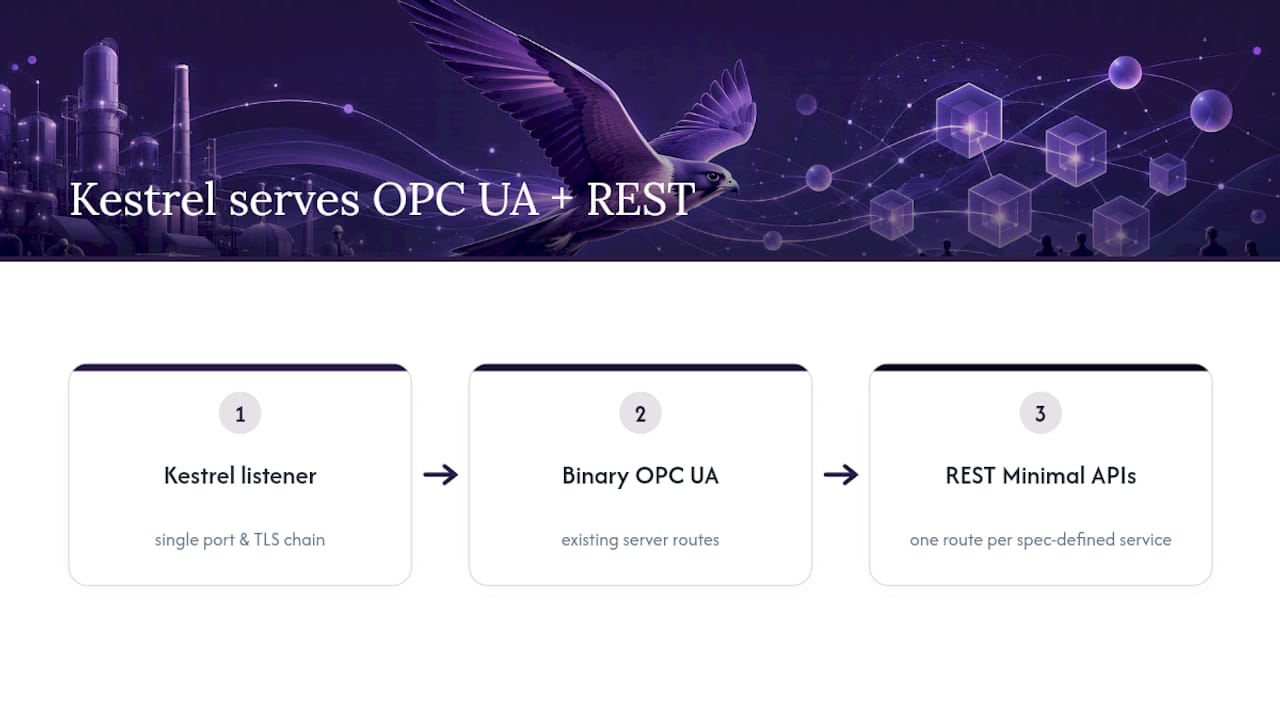
Client code doesn’t need a separate mental model either. A fluent helper, ManagedSessionBuilder.UseWebApiEndpoint, constructs the endpoint description so your application code calls the same ISession and subscription APIs whether it’s talking binary OPC UA or REST underneath. That symmetry is intentional: the OPC Foundation designed the client abstraction so migrating between transports doesn’t mean rewriting business logic.
For generating clients in other languages, the published OpenAPI definitions (available from v1.05.04 onward) work directly with standard tooling.
The OPC Connect writeup on OPC UA and OpenAPI walks through the generation workflow in more depth, and the UA-.NETStandard repository hosts the binding source and docs if you need to see how a given service maps under the hood.
Gateway Patterns When You Can’t Use the Native Binding
Not every OPC UA server in the field ships the official WebApi binding, especially older deployments running vendor stacks that predate the spec’s REST extension. That’s where a gateway earns its place, and the pattern you pick should match your team’s constraints, not the fanciest option on GitHub.
- Simple Node.js gateway — a thin translation layer using an OPC UA client library on one side and Express routes on the other; fastest to stand up, but you own all the mapping logic yourself.
- Full WebApi aggregator — replicates the official service surface but fronts multiple OPC UA servers behind one unified API, useful when you’re consolidating several plants or lines into one cloud endpoint.
- i3X-style normalized API — projects like i3x2ua expose a simplified, industry-agnostic REST surface with Server-Sent Events for live updates, aimed at teams that don’t want to reason about raw OPC UA semantics.
- Reverse-proxy plus API gateway — puts Nginx or a managed API gateway in front of any of the above for TLS termination, rate limiting, and centralized logging.
For subscription behavior, you have two real choices: Server-Sent Events or WebSockets for genuine push, which keeps the OPC UA publish/notify model intact, or polling endpoints when your client population is large enough that maintaining thousands of persistent connections becomes the bottleneck instead of the data itself. The UA-WebApi-StarterKit is worth cloning before you write any gateway code from scratch. It includes working server and client samples, including a React/TypeScript client, that show the intended request/response shapes.
Most teams running these in production put them behind Docker with a reverse proxy and export basic latency and error metrics, since a gateway that silently drops subscription events is worse than no gateway at all.
Mapping OPC UA Security to Web Authentication
The single most common mistake in OPC UA to REST projects is treating security as an obstacle to remove rather than a system to translate. Don’t disable OPC UA security controls to make the REST layer “simpler.” Forward or validate tokens instead of falling back to anonymous access.
- Terminate OAuth2/JWT authentication at the gateway or WebApi layer, validating the issuer and signature before any request touches the OPC UA session.
- Use mutual TLS between the gateway and the OPC UA server itself, so the OT-facing hop stays authenticated even if the web-facing hop uses bearer tokens.
- Map OPC UA user roles to JWT claims or ABAC policy attributes, rather than granting every authenticated web client the same session-level permissions.
- Apply rate limiting and audit logging at the API gateway tier, since REST endpoints are far more exposed to scraping and brute-force attempts than a binary OPC UA endpoint buried inside a plant network.
- Rotate server and client certificates on a defined schedule, and lock down CORS and response headers so browser-based clients can’t be tricked into cross-origin data leaks.
The UA-WebApi-StarterKit’s security samples demonstrate a working JWT-validated identity token flow, which is a solid reference implementation if you’re mapping this pattern for the first time.
Pro Tip: Test your token expiry and refresh flow against a live subscription before go-live. A gateway that silently drops a subscription when a JWT expires mid-session is a debugging nightmare in production, and it rarely shows up in a quick smoke test.
Rolling Out OPC UA to REST in Production
A production rollout has a predictable shape. Skipping steps here is how teams end up debugging timestamp mismatches at 2 a.m. instead of during a code review.
- Inventory every node and information model your integration actually touches, and separate must-have services (read, write, history, subscribe) from nice-to-haves.
- Check for native WebApi support. If present, enable the binding, fetch the OpenAPI spec, and generate clients for your target languages.
- If no native binding exists, deploy and configure a gateway, mapping each required OPC UA service to a corresponding REST endpoint.
- Implement authentication mapping (JWT validation, role-to-claim translation) before exposing any endpoint publicly.
- Standardize data-type translation, timestamp formatting, and OPC UA StatusCode-to-HTTP-status mapping so client teams get consistent, predictable responses.
- Add health and monitoring endpoints, then test subscription creation, notification delivery, and republish behavior under realistic load.
- Stage the cutover: run REST and binary endpoints in parallel, keep a documented fallback path, and write an incident runbook covering secrets rotation and certificate renewal.
| Rollout stage | Primary risk | Mitigation |
|---|---|---|
| Node inventory | Missing required services | Cross-check against the 28-service scope before committing to a binding |
| Binding/gateway setup | Type or timestamp mismatches | Validate against sample payloads before connecting real clients |
| Auth mapping | Anonymous fallback left enabled | Explicit review gate before production sign-off |
| Cutover | Subscription drops during migration | Parallel run with documented rollback path |
Choosing Between Native Binding, Gateway, or a Managed Platform
Your decision here should follow your constraints, not a general preference for “less custom code.”
- Native REST binding wins when your server already supports it. You get spec-guaranteed fidelity and standardized endpoints with the least engineering risk.
- A gateway makes sense when you need data transformation, multi-server aggregation, or a runtime/language your OPC UA vendor doesn’t support natively.
- A managed API lifecycle platform fits when the real problem isn’t the OPC UA mapping itself but everything around it: governance, audit trails, compliance evidence, and enterprise RBAC/ABAC across dozens of APIs, not just this one.
Regulated environments in particular tend to underestimate that third category until an audit forces the question.
How Jundago Approaches OPC UA-to-REST for Regulated Enterprises
Once your OPC UA data has an OpenAPI definition, whether from the native binding or a gateway, that definition becomes the input for governance work most teams handle manually with spreadsheets and tribal knowledge.
- API Studio can ingest an OpenAPI definition generated from your OPC UA mapping and generate governed REST, GraphQL, or gRPC surfaces without hand-writing boilerplate.
- EndPlex gives engineers a native workbench for testing and debugging those generated endpoints against real OPC UA payloads before anything reaches production.
- Command Center enforces RBAC and ABAC policies centrally, so the role-to-claim mapping you build for OPC UA security carries through to every downstream consumer of that API.
- Deployment targets span AWS, Azure, GCP, and Oracle Cloud, which matters when your OT integration needs to land in whichever cloud your compliance team already approved.
If you’re weighing whether to build this governance layer yourself or evaluate a platform built for it, the Jundago platform overview is worth a look before you commit engineering time.
What Trips Up Most OPC UA to REST Projects
The pitfalls I see repeated most often aren’t exotic. Teams simplify security to move faster, then quietly lose type fidelity translating OPC UA data types into loose JSON, and forget that subscriptions have real republish semantics that polling doesn’t replicate. Preserve the identity model, keep encoded types intact, and test republish behavior explicitly, not as an afterthought. The standardized OpenAPI mapping is genuinely pushing interoperability forward, but it doesn’t remove the engineering judgment this work still demands.
— vivek
Get a Governed REST Front End for Your OPC UA Data
Jundago gets your OPC UA data into a governed API without the manual work of mapping RBAC policies, compliance rules, and multi-cloud deployment by hand for every new endpoint.
Once you have an OpenAPI definition, whether from the OPC Foundation’s native binding or a gateway you’ve built, Jundago’s API Studio can turn it into a governed REST, GraphQL, or gRPC surface with RBAC and ABAC enforcement applied automatically through Command Center. That means your OT security mapping doesn’t stop at the gateway. It carries through to every team and application consuming that data downstream, across AWS, Azure, GCP, or Oracle Cloud. For regulated manufacturing environments where IEC 62443 and audit evidence are part of the job, that governance layer is usually the harder problem to solve, not the OPC UA mapping itself. Visit Jundago to see how the platform handles API generation and governance for your specific compliance scope.